Weekly Bangla Mirror | Bangla Mirror, Bangladeshi news in UK, bangla mirror news

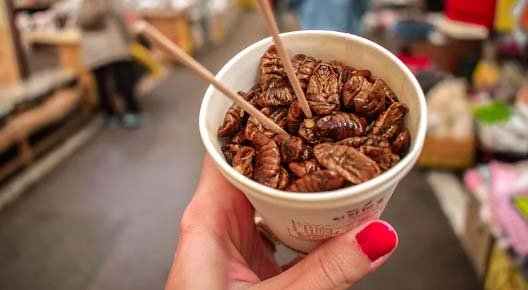
Insects are packed with nutrients and rich in protein
Bugs are a nutritious and sustainable source of protein. Why are we so squeamish about eating them?
From Kardashian protein popcorn to the TikTok trends of blended cottage cheese and chicken smoothies, people are going to extreme lengths to eat more protein. Worldwide search interest in “protein” has risen by 213% over the past decade, BBC analysis has found. It reached an all-time high in 2025, according to Google. Yet one protein source remains largely off the table in Western diets: insects.
Bugs are a nutritious source of protein, enjoyed as a staple in many parts of the world, particularly in Africa, Asia, Latin America and Oceania.
So what’s stopping the rest of us from eating insects? For many people, the idea of eating bugs triggers disgust. Some edible insects have been approved for sale by the European Food Safety Authority, but just one in 10 Europeans would consider swapping meat for insects, according to a 2020 report by the European Consumer Organization. Among Western European consumers, disgust is cited as a major reason for avoiding insects, along with cultural norms, food neophobia and concerns about safety.
Experts say that if people in the United States and Europe can get over the “ick”, edible insects could revolutionise food systems and be part of a climate-friendly solution to addressing world hunger. Around 2.33 billion people experience food insecurity, according to the World Health Organization (WHO). Insects could help address this issue.
Packed with nutrients and requiring fewer resources than traditional livestock, insects offer a sustainable alternative to meat. “If you look at the protein, per kilogram, insects are very environmentally sustainable,” says Jessica Fanzo, director of the Food for Humanity Initiative at Columbia University in New York. They require less energy and resources (like land, water and feed) to produce than beef or poultry does, says Fanzo.
Take steak, for instance. Beef is a major contributor to greenhouse gases, particularly methane, a short-lived potent greenhouse gas which is around 80 times more harmful over a 20-year time span than carbon dioxide (CO2). Rearing livestock is also the number one driver of tropical deforestation and uses a significant amount of water. Edible insects have a much lower carbon footprint than livestock animals such as cattle or sheep.
But disgust is an overpowering emotion. Disgust evolved as a survival mechanism – a visceral alarm against potential threats. It is also a learned response, influenced by cultural norms. When instinct and conditioning join forces, overcoming disgust becomes a challenge.
“The disgust response is strong,” says David Pizarro, a psychology professor at Cornell University in New York. Pizarro’s research raises the possibility that disgust sensitivity shapes moral judgements.
“Disgust is closely tied to our sense of purity,” says Pizarro, whose findings have posed that people with greater disgust sensitivity tend to hold more traditional views. “There’s a general wariness of novelty that tends to align with conservative attitudes,” Pizarro explains.
“At some point in the future, we’ll be consuming insects more,” says Pizarro. “The question is: how do we get there?”
Fanzo notes that food norms are arbitrary. “Eggs are kind of weird,” Fanzo says. “Why do we eat eggs? Why did we [decide] that eggs are normal but eating crickets is not?”
One reason for the revulsion is that insects are usually eaten whole – legs, eyes and all. This reminds consumers that their food was once alive. In industrialised food systems, people are often disconnected from the origin of their meat.
“You don’t recognise the animal in your food,” says Antônio Rocha Bisconsin-Júnior, a food science professor at the Federal Institute of Education, Science and Technology in Rondônia, Brazil. (Read more about how the “meat paradox” affects what we eat).
A 2025 study found that most farmed insects are used as animal feed, not human food. Even when insects are added to products, they rarely replace meat. And because insects are often fed the same grains as livestock, insect farming can be inefficient.
“Insects have had an ‘environmental halo’,” says Dustin Crummett, executive director of the Insect Institute and a lecturer at the University of Washington Tacoma.
Reducing meat consumption isn’t just about finding a sustainable protein source, Crummett says. It’s about offering an alternative that matches meat’s sensory appeal and cultural familiarity, which makes insects a tough sell to people in the US, he adds. “It’s going to be hard to get Americans to eat cricket burgers.”
However, one economic forecast predicts that the US market value of edible insects will increase 450% by 2032, according to a 2022 report.
For Bisconsin-Júnior, entomophagy (insect eating) is both professional and personal. Growing up in an Amazonian region of Brazil, Bisconsin-Júnior ate “gongo”, or bouncy beetle larvae nuzzled inside coconuts – a local delicacy. “My friends and I trekked inside the rainforest, opening coconuts, and if there’s larvae inside, we ate them,” recalls Bisconsin-Júnior. “It’s a sweet coconut-like flavour.”
Bisconsin-Júnior’s research in Brazil finds three main barriers to commercial insect food production and consumption: legislation, price and disgust. The first two obstacles are structural, involving new regulation and economic supply chains. The infrastructure for mass-producing and distributing edible insects is still developing in Western nations, including in Brazil, says Bisconsin-Júnior. But the last issue is psychological and tied to cultural connotations, he says.
“Many associate insects with disease,” explains Bisconsin-Júnior. “Those associations become emotion: disgust. When you see an insect, you feel disgust.”