Weekly Bangla Mirror | Bangla Mirror, Bangladeshi news in UK, bangla mirror news

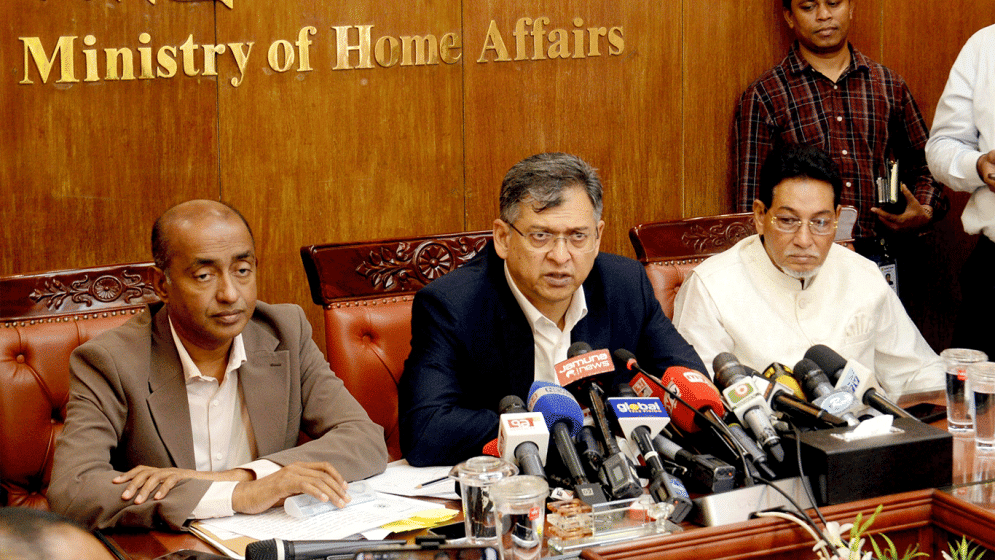
Home Minister Salahuddin Ahmed has said the government has set a “unique precedent” in parliamentary democracy by disposing of 133 ordinances within a short time during the first session of the 13th Jatiya Sangsad.
He made the remarks at a press briefing held at the Ministry of Home Affairs conference room at the Bangladesh Secretariat on Sunday, focusing on the ordinances placed before parliament, said a press release.
The main statement at the briefing was delivered by Law, Justice and Parliamentary Affairs Minister Md Asaduzzaman. Chief Whip Nurul Islam Moni was also present.
The home minister said that under Article 93 of the Constitution, there was a legal obligation to settle ordinances issued during the previous government within 30 days of the commencement of the parliamentary session. Despite a reduced number of working days due to the holidays of Eid al-Fitr and Shab-e-Barat, the task was completed through the tireless efforts of officials from the Parliament Secretariat, the law ministry, BG Press, and the Ministry of Public Administration.
He noted that given the time constraints, the bills were introduced and disposed of in accordance with the Rules of Procedure under the special authority of the speaker of the Jatiya Sangsad.
The minister further said that since standing committees had not yet been formed, a “special parliamentary committee” reviewed all 133 ordinances. Based on its recommendations, 98 ordinances were approved “as is” unanimously. Another 16 will be presented as bills in the next session for further scrutiny, while the remaining ordinances were either amended or included in the list for repeal and preservation.
Responding to questions and misunderstandings raised by the opposition leader regarding the number of bills presented in parliament, he said the law minister had already clarified that multiple amendments to the same ordinance were consolidated into a single bill when placed before parliament, which may have caused confusion.
On the opposition’s walkout over the “July Mass Uprising Memorial Museum” bill, the home minister said the government remains sensitive and open to improvements. He noted that there is scope to make provisions regarding the appointment and resignation of curators more transparent and reasonable, and that the bill could be further discussed and revised in the next session.
Addressing issues related to enforced disappearances, the Human Rights Commission, and ICT laws, he said the government does not want to rush through flawed legislation that could allow offenders to escape through legal loopholes.
“We will remove inconsistencies and consult all stakeholders to make these laws more modern and effective, ensuring maximum justice for victims,” he said.
He added that while opposition parties have the right to stage walkouts in line with parliamentary norms, spreading misinformation outside parliament is not acceptable. He noted that the Speaker had allowed opposition members unprecedented time to speak and ensured their dissenting views were fully recorded in official reports.
Despite that, he said, the walkout on an issue of public importance was not justified.