Weekly Bangla Mirror | Bangla Mirror, Bangladeshi news in UK, bangla mirror news
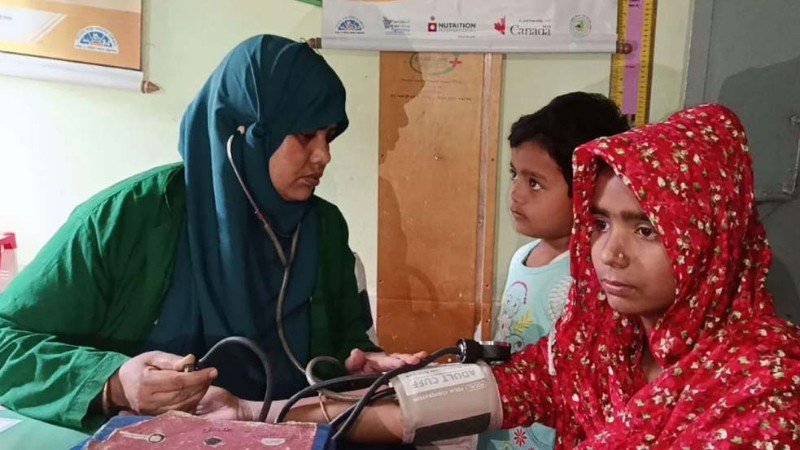
Meherun Nehar Lily doing the check-up of a pregnant patient. Photo: Collected
At a time when private hospitals and clinics across Bangladesh have turned Caesarean sections into a lucrative business to the clinic oparators, a health worker in a remote corner of Tetulia upazila in Panchagarh has spent the last decade building the opposite kind of reputation.
Meherun Nehar Lily has worked at the Kazipara Community Clinic in Burabari union in the district for ten years now. In that time, she has personally overseen roughly 1,500 normal deliveries. There is no operating theatre here, no surgical backup of any kind, and yet families from across the area now come to her the moment labour begins.
The reason is straightforward enough. The nearest upazila health complex is about 20 kilometres away, and Panchagarh’s district hospital is a further 35 kilometres beyond that. For a woman in labour, that distance can be the difference between a safe delivery and a dangerous one.
The clinic itself was set up in 1998 on land donated by a local resident named Romina Khatun and over the years it has become for many families the only realistic option.
Lily joined as a Community Health Care Provider in 2011. Three years later, she completed a six-month long “Community Skilled Birth Attendant” course at Thakurgaon Sadar Hospital, and by early 2015 she had begun handling normal deliveries on her own.
She still remembers how nervous she was the first time. “I was terrified,” she said. “But within an hour, the baby was born safely, by the grace of Allah. That success gave me the confidence to keep going.”
“People were hesitant at first”, she said. Trusting a community clinic with childbirth is not a small thing. But that hesitation gave way to trust, and now women travel from well beyond the immediate area to deliver under her care.
Her routine has stayed consistent over the years: regular checkups and counselling well before labour starts, quick contact once contractions begin, and prompt referral to a hospital whenever a case looks risky.
Not every situation allows for that referral, though. When a hospital transfer simply isn’t possible, she says, there is no choice but to manage the delivery herself, as carefully as she can.
Residents describe her work in similar terms, even if the words differ. Kulsum Akhter said the clinic has been a genuine relief for poor families, as deliveries and medicine are both available without the cost that comes with going elsewhere.
Laili Akhter’s eldest daughter was delivered there; she didn’t have to travel far. Lipa Akhter had both her children at the clinic, without any major expense. Abu Taleb put it simply: with close to 1,500 normal deliveries behind it, the clinic has become something like a blessing for the area.
Panchagarh’s Civil Surgeon Mizanur Rahman holds it up as a model. Of the 110 community clinics operating in the district, he said, Kazipara stands out for how it delivers normal birth services.
Lily, as a trained CSBA, has carried out that work with skill and sincerity for years, and because of her, mothers in an otherwise underserved area are getting safe deliveries close to home.
That picture looks very different elsewhere in the country. In Jashore, a deadline set by the health minister for private hospitals and clinics to establish labour rooms has already passed, and most facilities still haven’t complied.
The allegation is a familiar one–hospital owners are dragging their feet to protect a profitable Caesarean business. Of the district’s 189 private hospitals and clinics, the majority have yet to set up dedicated normal-delivery rooms–even as patients are charged anywhere from Tk20,000 to Tk60,000 for C-sections.
Set the two districts side by side and the contrast is hard to ignore. In one, a single trained health worker has delivered some 1,500 babies safely, at little to no cost, in a village most policymakers will never visit.
In the other, well-established city hospitals are stalling on a direct government order, apparently to keep a far more profitable arrangement intact.
What Lily’s work ultimately shows is that normal delivery isn’t just possible with the right training and genuine commitment–it’s safe. Whether that becomes the norm elsewhere depends less on what’s proven in places like Kazipara, and more on whether anyone is willing to actually enforce it.