Weekly Bangla Mirror | Bangla Mirror, Bangladeshi news in UK, bangla mirror news
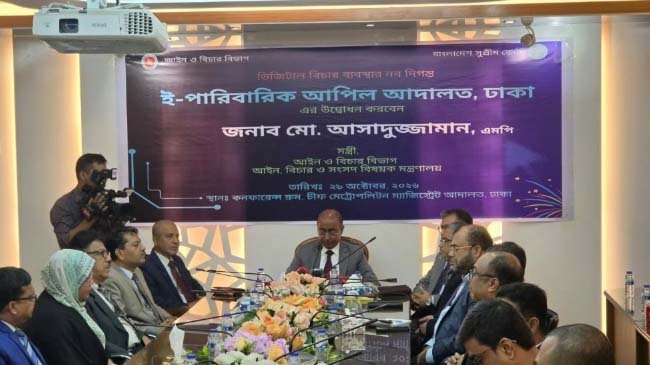
Law, Justice and Parliamentary Affairs Minister Md Asaduzzaman speaks at the inauguration program of the country’s first E-Family Appeal Court at the conference room of CMM on 29 October 2026. Photo: Collected
Law, Justice and Parliamentary Affairs Minister Md Asaduzzaman on Thursday said artificial intelligence (AI) would pose the biggest challenge to the judiciary in the coming days.
“When you rely on AI to write judgments or record signatures and statements, there is a risk that justice will be defeated,” he said, warning that AI could now imitate people’s voices with such precision that it could become a major challenge for judges in the future.
He made the remarks at the inauguration of the e-Family Appellate Court at the conference room of the Chief Metropolitan Magistrate (CMM) Court in Dhaka.
The law minister said the government planned to digitise judicial processes across the judiciary and was also considering introducing digital appearances for accused persons instead of transporting them from prisons to courts.
Digitising the process would save both time and money, he said, adding that under the system, an accused person would remain in prison while the relevant official verified their presence and the court recorded the appearance digitally. It will be a groundbreaking initiative.
Addressing judges, Asaduzzaman said they needed to improve their digital skills to safeguard justice and address the challenges posed by AI. “I believe you are ready to take up this challenge and keep pace with the changing times,” he said.
Addressing journalists, the minister urged them to report irregularities in the judiciary and suggest ways to improve its functioning. Such recommendations would be considered seriously, he said, while cautioning journalists against unnecessarily harassing judicial officers.
Highlighting efforts to reduce the backlog of cases, Asaduzzaman said pre-case mediation had been introduced to resolve disputes before they reached court.
According to him, the initiative was operational in 30 districts, with disputes being referred for mediation before the filing of cases under 11 laws. The minister claimed that the success rate of the process had exceeded 62%.
Addressing the large number of pending cases, the minister said the country currently had more than 4.6 million cases pending before courts. Describing the backlog as a monumental challenge for around 2,300 judges, he said the pressure was particularly high in metropolitan areas, including Dhaka and Chattogram.
Urging judges to take a more proactive approach to disposing of cases, Asaduzzaman said they should not approach their work merely as a job but play an active role in ensuring timely justice.
Warning judicial officers against negligence, the minister said he had received reports that some officials arrived at work around 11:00am and left by 2:00pm or 3:00pm.
Such a relaxed approach to official duties was unacceptable, he said, adding that action would be taken against those found neglecting their responsibilities.
Emphasising public participation in lawmaking, Asaduzzaman said opinions from people across different professions and social groups should be sought before laws directly affecting the public were enacted.
He cited amendments to the Human Rights Commission Act and cyber laws as examples of initiatives in which opinions from different stakeholders had been sought. He also said consultations were under way with various groups on constitutional amendments.
Among those present at the programme were Dhaka District and Sessions Judge Md Rafiqul Islam, Dhaka Metropolitan Sessions Judge Md Shahjahan Kabir, Chief Metropolitan Magistrate Mohammad Mostafizur Rahman, Metropolitan Public Prosecutor Omar Faruque Faruqui, Government Pleader (GP) for the District and Sessions Judge Court Iqbal Hossain, officials of the Law Ministry, judicial officers and other court-related personnel.