Weekly Bangla Mirror | Bangla Mirror, Bangladeshi news in UK, bangla mirror news

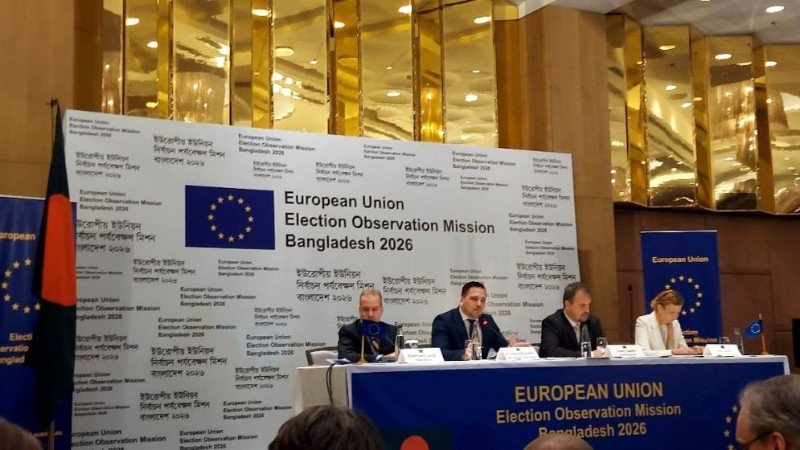
The European Union Election Observation Mission (EU EOM) has described Bangladesh’s 2026 parliamentary elections as credible and competently managed, marking what it called a pivotal step towards restoring democratic governance and the rule of law.
Presenting its preliminary findings at a press conference held at the Hotel InterContinental in the capital on Saturday, the mission stated that, for the first time since 2008, elections in Bangladesh were genuinely competitive.
The polls were conducted under a renewed legal framework that largely accords with international standards, with fundamental freedoms broadly respected.
However, the mission noted that sporadic localised political violence and the spread of manipulated online narratives harmed the democratic process. It also expressed concern over the limited political space for women, which it said significantly undermined their participation.
The EU observers said the Bangladesh Election Commission worked independently and transparently, maintaining the confidence of stakeholders and upholding the integrity of the polls.
Legal Framework and Election Administration
The mission concluded that the electoral legal framework was generally conducive to the conduct of democratic elections. The 2025 amendments were seen as having strengthened inclusion and credibility.
Nonetheless, the EU recommended further reforms to enhance legal certainty and close loopholes that weaken institutional accountability and transparency.
The newly appointed Election Commission was commended for adopting a proactive approach to rebuilding public trust. It was noted that the interim government and other stakeholders extended support to the Commission.
The Commission was found to have worked transparently, responded to media queries promptly, shared information of public interest and maintained dialogue with political parties.
However, stringent campaign rules were not always consistently enforced, which at times fuelled perceptions of bias and contributed to grievances raised by various political parties, including two major coalitions.
Polling Day and Counting
Election-day preparations were described as professional and timely. Around 770,000 voters living abroad were enfranchised through postal ballots. More than 850,000 polling staff were trained, and election materials were distributed smoothly.
On polling day, observers reported dedicated polling officials and a continuous presence of party agents from both major coalitions, which enhanced transparency. However, most polling stations were not accessible to voters with reduced mobility, limiting their ability to participate independently.
Vote counting and tabulation were generally handled competently. Nonetheless, some integrity safeguards were not uniformly implemented, and required checks were not always performed during counting. In three cases observed by the mission, tabulation lacked transparency.
Despite these shortcomings, party agents were generally able to follow the process, and returning officers provided regular updates on results, helping to build public confidence in the outcome.
Candidate Nomination and Campaign
The mission underscored that the competitive nature of the election was rooted in the candidate nomination process. The Election Commission handled over 600 appeals and reinstated two-thirds of rejected nominees, safeguarding the fundamental right to stand for election.
More than 200 candidates contested the polls, offering voters a broad range of political alternatives. EU observers attended over 200 campaign events across the capital and districts, meeting candidates and party representatives.
The campaign was described as dynamic, with candidates enjoying freedoms of assembly and expression. However, rhetoric intensified towards the end of the campaign, shifting from policy debates to personal attacks and allegations of misconduct, often amplified on social media.
Intra-party conflicts and local patronage networks were also found to have affected the level playing field in certain constituencies.
Women’s Participation
The mission identified the limited participation of women as a notable setback in what it termed a “historic election”. While women were at the forefront of the July mass uprising demanding good governance and an end to corruption, they were largely absent as candidates in this election.
Only 4 per cent of contestants were women, which the mission said reflected a clear lack of political will to advance women in national politics, despite commitments made in the July Charter.
Other barriers cited included patriarchy, discrimination, digital harassment and character assassination.
Minorities and Political Inclusion
The EU EOM held discussions with representatives of indigenous communities and religious minorities in Dhaka and other regions. Many expressed feelings of marginalisation and disappointment that their hopes for meaningful political representation and change remained unfulfilled.
The mission also voiced concern about the increasing prominence of religious rhetoric in public discourse, including online.
Violence and Online Disinformation
The EU reported at least 56 campaign-related incidents involving physical violence, resulting in around 100 casualties, mainly in southern districts. These incidents, while localised and not indicative of a systematic pattern, included intimidation, harassment—particularly of women campaigners—and attacks on property.
The mission stressed that any form of violence, whether physical or digital, has no place in democratic elections and extended condolences to the families of victims.
Online campaigning, particularly among the country’s 55–60 million social media users, was characterised by polarisation and limited space for respectful political debate. The EU’s social media monitoring unit identified widespread disinformation, with several pieces of content receiving over one million views within 24 hours.
Influencers and deceptive media accounts—primarily operating on Facebook and TikTok—were identified as key vectors of disinformation. While some originated outside Bangladesh, most appeared to be domestically coordinated. Social media platforms were criticised for responding too slowly, although national fact-checking initiatives were noted as effective in countering false narratives.
Media and Civil Society
The mission observed that several private media outlets made genuine efforts to provide balanced election coverage, including talk shows featuring candidates and investigative reporting. Such practices were described as positive steps enabling voters to make informed choices.
However, media reform remains incomplete. News organisations were found to be vulnerable to pressure, fostering self-censorship and limiting space for analytical reporting.
Civil society was praised for its significant contribution to restoring public confidence in the electoral process. A total of 81 citizen observer groups were accredited to monitor the polls, enhancing transparency. Young activists also engaged in voter education initiatives aimed at improving political literacy and promoting respect for human rights.
The EU mission concluded that these civic efforts give grounds for optimism about the consolidation of democracy in Bangladesh.