Weekly Bangla Mirror | Bangla Mirror, Bangladeshi news in UK, bangla mirror news
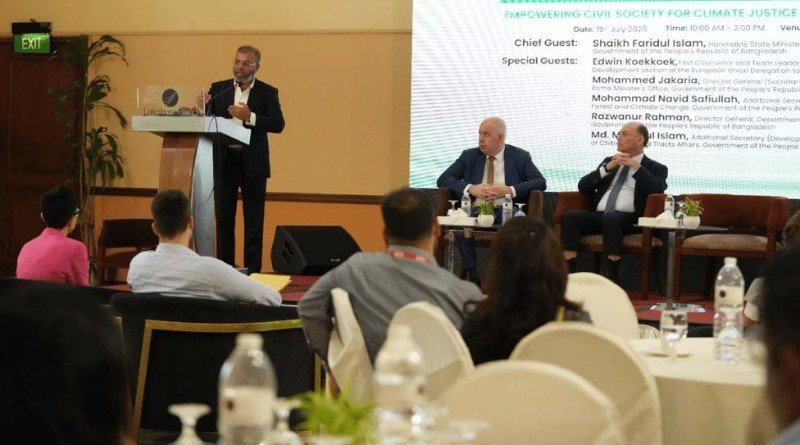
State Minister for Environment, Forest and Climate Change Shaikh Faridul Islam speaking about the government’s climate action at Hotel Lakeshore in the capital on Sunday. Photo: Collected Photo
State Minister for Environment, Forest and Climate Change Shaikh Faridul Islam said on Sunday that the government is placing nature-based solutions at the heart of its climate strategy, with a renewed focus on climate justice, environmental protection and stronger community participation.
Faridul made the remarks while speaking as the chief guest at the launch of the European Union-funded project “Empowering Civil Society for Climate Justice and Environment Protection” at Hotel Lakeshore in the capital.
The four-year project, implemented by Welthungerhilfe (WHH) in partnership with Educo, Manusher Jonno Foundation and Uttaran, aims to strengthen grassroots civil society organisations (CSOs) to promote climate justice, environmental protection, human rights and inclusive climate governance across Bangladesh.
The project will provide direct financial and technical support to 18 grassroots civil society organisations, including women-led organisations, Indigenous Peoples’ groups, Dalit organisations and youth groups, through the Financial Support to Third Parties (FSTP) mechanism.
“We have to focus more on results. Our government is committed to supporting every initiative that brings positive change for our people and the country,” the minister said.
He said the government has adopted a series of nature-based solutions, including a programme to plant 250 million trees, restore canals, expand renewable energy, improve waste management and introduce electric buses to reduce carbon emissions and environmental degradation.
The minister said the government has also decided to gradually phase out old, highly polluting buses and modernise traditional brick kilns, which remain among the country’s largest sources of air pollution.
Referring to a recent government review, he said more than 5,000 of the country’s nearly 7,500 brickfields are operating illegally despite paying only a small amount in official annual fees.
“We need to stop this nonsense. We must identify those who are accepting bribes. Corruption cannot persist in this sector,” he said.
The minister said around 720,000 people are expected to benefit directly from the initiative, which will cover climate-vulnerable coastal areas, flood-prone plains and hill districts.
Jonas Wiahl, country director of Welthungerhilfe Bangladesh, said the success of the project would depend not only on activities but also on trust, partnerships and collective action.
“By working together, learning from one another and building shared strength, we will create long-lasting transformative change,” he said.
Shaheen Anam, executive director of Manusher Jonno Foundation, said meaningful climate action requires strong collaboration among civil society, government institutions and citizens.
“The outcome of the project cannot be achieved by any donor, partner or stakeholder alone. It requires close collaboration among civil society, local authorities and citizens’ groups,” she said.
Representing the European Union, Edwin Koekkoek reaffirmed the EU’s commitment to supporting Bangladesh’s climate resilience efforts.
“The EU remains fully committed to working with Bangladesh to address climate change, promote human rights and strengthen civil participation to ensure inclusive development,” he said.