Weekly Bangla Mirror | Bangla Mirror, Bangladeshi news in UK, bangla mirror news
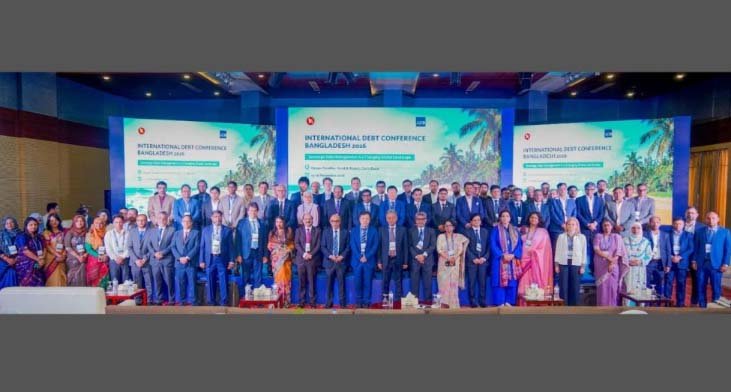
Photo: Courtesy
Bangladesh aims to become a trillion-dollar economy by 2034, Finance and Planning Minister Amir Khosru Mahmud Chowdhury said on Sunday, emphasising the need for prudent borrowing, fiscal discipline and sustainable financing.
Addressing the inaugural session of the two-day International Debt Conference Bangladesh 2026 in Cox’s Bazar, the minister identified rising debt-servicing obligations, weak revenue mobilisation and limited fiscal space as major economic challenges.
“Our objective must be to ensure that every taka borrowed contributes meaningfully to economic growth, productivity and public welfare,” he said, adding, “Our ambition is not simply to access international capital markets, but to do so responsibly and sustainably.”
He said the government was also exploring innovative financing instruments, including sovereign Sukuk, green and blue bonds, and blended finance.
“The true measure of successful sovereign borrowing is not how much a country borrows, but how effectively those resources contribute to economic growth, public welfare and long-term prosperity,” he added.
The Finance Division of the Ministry of Finance and the Asian Development Bank (ADB) jointly organised the conference on 15-16 November under the theme ‘Sovereign Debt Management in a Changing Global Landscape’.
The conference brought together policymakers, government officials and financial experts from Bangladesh and abroad to discuss sustainable borrowing strategies amid rising financing costs, global economic uncertainty and changing international capital markets.
Participants included officials from the Finance Division, Economic Relations Division, Internal Resources Division, Financial Institutions Division, National Board of Revenue and Bangladesh Bank, as well as representatives from the debt management offices of Sri Lanka, Pakistan, Indonesia and Malaysia. Officials from the ADB, World Bank and International Monetary Fund (IMF), alongside national and international experts, also attended.
Finance Secretary Dr Md Khairuzzaman Mozumder chaired the opening session, which was also addressed by Tanvir Shahriar Ghani, Special Assistant to the Prime Minister; Nazma Mobarek, Secretary of the Financial Institutions Division; and Qingfeng Zhang, ADB Country Director for Bangladesh.
Hasan Khaled Foisal, Additional Secretary of the Finance Division, gave an overview of the conference, while S M Ebadur Rahman, Lead Social Sector Officer at the ADB Bangladesh Resident Mission, delivered the welcome remarks.
Tanvir Shahriar Ghani said Bangladesh should explore raising funds through dollar-denominated Eurobonds and Sukuk while carefully assessing its borrowing capacity.
He said Bangladesh’s inclusion in a JP Morgan emerging-market government bond index could enhance the profile of its securities. However, attracting foreign investors would require sound economic fundamentals, transparent trading and reliable arrangements for repatriating investment proceeds.
Ghani also called for stronger links with international settlement platforms and closer integration between banks and capital markets to finance large industrial projects.
Dr Md Khairuzzaman Mozumder said the Finance Division was working to publish an annual borrowing plan to make government financing more predictable and transparent as Bangladesh prepares to graduate from least developed country (LDC) status.
He said fluctuations in global interest rates and exchange rates had made government borrowing increasingly complex.
The finance secretary outlined plans to improve reporting on domestic and external debt and debt-servicing obligations, strengthen auctions of Treasury bills and bonds, and broaden the investor base.
Nazma Mobarek said Bangladesh’s annual interest payments on external debt, measured in taka, were projected to more than double between FY2024-25 and FY2028-29.
She added that public debt stood at less than 39 per cent of GDP at the end of FY2024-25 and was expected to remain close to that level through FY2028-29.
Qingfeng Zhang said rising debt-servicing costs were squeezing Bangladesh’s development spending and increasing its reliance on domestic borrowing.
He said total debt servicing rose to 3.0 per cent of gross domestic product in FY2024-25 from 2.3 per cent in FY2020-21.
Zhang called for greater transparency in public debt disclosures, including government guarantees, and closer coordination among borrowing, cash management and budget planning to ensure smoother debt repayments.
He also urged Bangladesh to deepen its domestic bond market, strengthen project appraisal and procurement, and improve oversight of state-owned enterprises and public-private partnerships to contain fiscal risks.
The conference comes as developing economies face increasingly complex decisions about financing public investment, managing debt-servicing obligations and maintaining fiscal stability.
A key focus of the discussions is how countries can use borrowing to finance infrastructure development, create employment and accelerate economic growth without generating unsustainable fiscal pressures.
Prasad Ananthakrishnan, an ADB consultant and former IMF adviser, delivered a special address on the relationship between sovereign borrowing, productive investment and economic growth.
His presentation examined the conditions under which public borrowing can generate economic benefits and the circumstances in which excessive debt risks undermining fiscal stability or crowding out private investment.
The conference is also focusing on the challenges facing economies graduating from LDC status, particularly their efforts to diversify financing sources and expand access to international capital markets.