Weekly Bangla Mirror | Bangla Mirror, Bangladeshi news in UK, bangla mirror news
Collected Photo
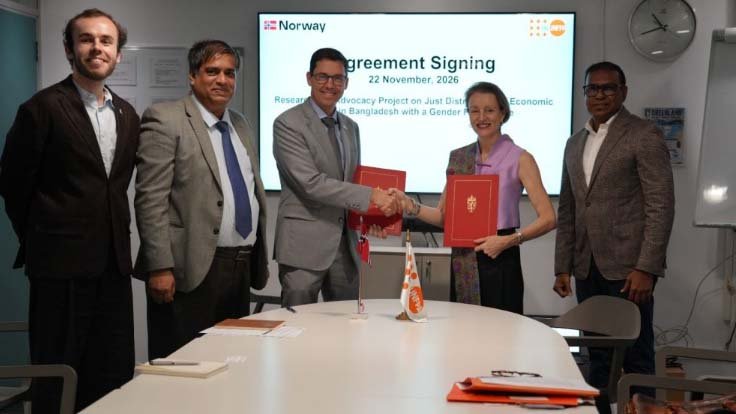
The Norwegian Embassy in Dhaka and the United Nations Population Fund (UNFPA) on Sunday signed an agreement to jointly conduct research on how women share economic gains in Bangladesh amid persistent gender-related impediments.
The research project would also provide recommendations for bridging the gender gap in exploiting national economic gains, and empowering women in the long run.
Håkon Arald Gulbrandsen, ambassador of Norway to Bangladesh, and Catherine Breen Kamkong, UNFPA representative in Bangladesh, signed the agreement at the Embassy in Dhaka.
Bangladesh cut its poverty rate from 24.3% in 2016 to 18.7% in 2022, and girls now enrol in secondary school at higher rates than boys.
However, over the same period income inequality widened, with the national income Gini coefficient rising from 0.482 to 0.499, according to the Bangladesh Bureau of Statistics. Women have gained less than men. About four in ten women are in the labour force, compared with eight in ten men, and women spend an average of 5.8 hours a day on unpaid domestic and care work, against 0.8 hours for men.
The research will examine the channels that decide who benefits from growth: jobs and wages, unpaid care, ownership of land and other assets, and public spending on social protection, health and education. It will also look at how technological disruption, including automation, and climate shocks are changing the picture.
The findings will be published by June 2027 as a peer-reviewed research paper and discussed with policymakers, researchers, civil society and the media at a policy dialogue and a dissemination seminar in Dhaka.
“Women have been central to Bangladesh’s growth, in garment factories, on farms and in the unpaid work that keeps households running. Whether they share fairly in what they help produce is a question that needs better evidence than we have today,” said Catherine Breen Kamkong of UNFPA.
“The barriers that hold women back economically are priorities for UNFPA. Some of these include high rates of violence women experience in their homes and lives, difficulties accessing family planning, being married as children and being unable to complete their schooling. We are grateful to Norway for enabling a deeper inquiry to find answers.”
“Norway’s experience is that a fair distribution of gains and strong economic growth go hand in hand,” said Norway Ambassador Gulbrandsen. “We are glad to support Bangladeshi researchers in building the evidence for policies that let women share fully in their country’s progress.”
In 2025 Norway was the largest contributor to UNFPA’s core resources worldwide, providing $55 million. Core funding is not tied to specific projects, so UNFPA can move it quickly to where needs are greatest. In Bangladesh, Norway has also provided 10 million Norwegian Krone through UNFPA’s humanitarian appeal across 2025 and 2026, helping sustain essential services in Cox’s Bazar amid severe humanitarian funding constraints.