Weekly Bangla Mirror | Bangla Mirror, Bangladeshi news in UK, bangla mirror news
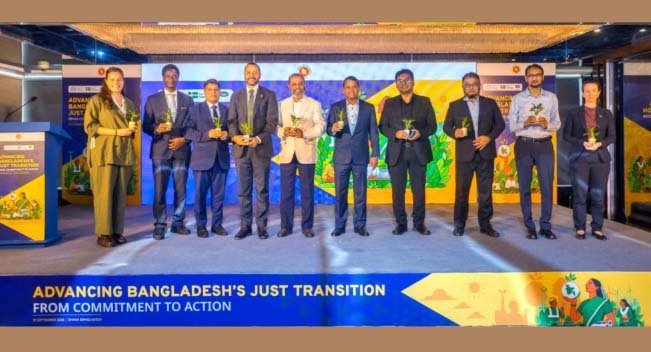
Photo: Collected
Speakers on Thursday said climate action must ensure decent work, protect livelihoods and promote inclusive growth, calling for reliable, disaggregated data to identify vulnerable groups and better target social safety net programmes.
They also recommended for focusing on creating employment through green transition, requiring sector an occupation level mapping to identify where jobs will be generated or lost.
Thy made the remarks at a dialogue titled, “Advancing Just Transition in Bangladesh,” led by the Department of Environment (DoE) under the Ministry of Environment, Forest and Climate Change (MoEFCC), with technical support from the International Labour Organization (ILO) and the South Asian Network on Economic Modeling (SANEM), funded by Sweden through the ILO–Sida Global Partnership.
Mirza Shawkat, director of climate change and international convention ar DoE, Elisa Benistant Fremigacci, technical officer of Just transition at ILO, Dr Selim Raihan, professor of Economics at University of Dhaka and executive director of SANEM presented technical issues at the event.
According to the presentations, Bangladesh’s “Just Transition” Chapter under its updated Nationally Determined Contributions (NDC 3.0) sets out 69 concrete, traceable activities across six sectors, backed by a combined $1.85 billion investment envelope.
The chapter was built on a cross-mapping of 14 national policy documents, including NDC 3.0, the National Adaptation Plan, the Bangladesh Delta Plan 2100, the 8th Five Year Plan and Perspective Plan 2041, identifying 258 aligned commitments that were distilled into 33 priority commitments.
These, in turn, anchor a consolidated action matrix of 69 activities spanning energy, transport, construction, agriculture, waste, and industrial processes and product use (IPPU), each with its own responsible institution, budget, timeframe and success measure.
Of the $1.85 billion envelope, $250.6 million represents direct cost covering training, grants and institutional strengthening, while $1,597.5 million reflects capital to be mobilised through commercial finance and development finance institutions such as IDCOL, rather than direct government spending.
The total envelope amounts to just 1.59% of the overall estimated cost of implementing NDC 3.0.
The chapter was shaped through six rounds of consultation between July and September, including a technical webinar, inter-ministerial tripartite sessions, sector-specific and thematic consultations, and two validation webinars, engaging close to 200 counterparts from ministries, employers, workers, the private sector, civil society, youth and academia.
The National Alliance for Just Transition Bangladesh (NAJTB), representing workers across 17 sectors, and the Bangladesh Employers’ Federation (BEF) were among the key counterparts consulted.
Shaikh Faridul Islam, state minister of environment, forest and climate change, Dr Md Saimum Parvez, special assistant to the prime minister (Environment), Mohammad Navid Saffiullah, additional secretary (Climate Change), Dr Md Lutfor Rahman, director general of Department of Environment (DoE), Abdur Rahim Khan, additional secretary of Labour Wing at MoLE spoke at the event.
Moustapha Kamal Gueye, director of Just Transition Priority Action Programme at ILO, Max Tunon, country director of ILO Bangladesh, Dr Fahmida Khatun, Fellow at CPD, Abul Bashar, executive director of sustainable finance at Bangladesh Bank, Farooq Ahmed, secretary-general of Bangladesh Employers’ Federation (BEF), Md Shamsul Islam, deputy secretary and focal point of just transition at MoLE, and Mesbahuddin Ahmed, chairman of National Coordination Committee for Workers’ Education (NCCWE), were present in the programme.