Weekly Bangla Mirror | Bangla Mirror, Bangladeshi news in UK, bangla mirror news

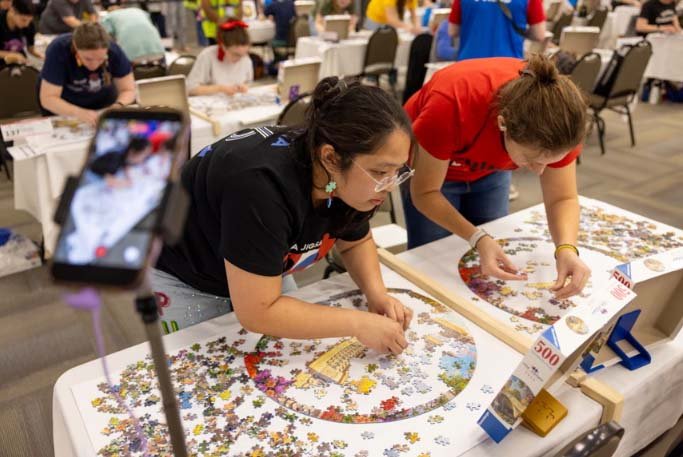
A PhD student in Berkeley. A 12-year-old in Texas. A content creator in Washington. An undergrad at Stanford. A former math teacher turned homeschool mom in Texas. After a three-day competition in Atlanta, Georgia, these people became national champions for a burgeoning hobby: speed jigsaw puzzling.
I have been a lifelong jigsaw puzzle lover. But in recent years, I have observed the quintessential way to slowly pass time transform into a competitive sport. So I traveled to the USA Jigsaw Nationals to test my skill against the best puzzlers in the country.
The competitive aspect of jigsaw puzzling dates back to the 1980s in the US, when Hallmark ran a national competition for several years. In 2022, the volunteer-run USA Jigsaw Puzzle Association (USAJPA) partnered with Ravensburger, one of the world’s leading manufacturers of jigsaw puzzles, to bring back a national championship.
The first competition had 300 attenders. This year, more than 1,600 gathered at the AmericasMart Atlanta, including over 1,000 competitors as well as supporters and hundreds of volunteers.
The jigsaw puzzle community blossomed during the Covid-19 lockdown.
“We didn’t have enough [puzzles], the demand was infinite,” says Thomas Kaeppler, the president of Ravensburger North America.
With in-person events at a halt, online puzzle competitions began to gain traction through virtual events held at speedpuzzling.com, created in 2020 by Jonathan Cluff. Social media helped it spread. Karen Kavett, a YouTuber who previously worked for HGTV, saw several of her speed puzzling videos go viral.
“Suddenly this audience that had no idea that speed puzzling was a thing sees that it’s a thing, and they tag all their friends and they’re like, ‘Oh my gosh, you would be so good at this,’” Kavett says.
‘Genuinely some of the most kind people’: who is the jigsaw puzzle community?
I walk around the convention before the first qualifying round begins, pacing the two floors. Attenders wear colorful skirts and earrings adorned with piece designs. Teams have coordinated their outfits – T-shirts, velvet tracksuits and hand-knit vests – customized with names such as “Puzzycat Dolls” and “Jigsaw Jamm”.
Ancillary activities are available during and in between rounds. Casual competitions for puzzle chess are under way: puzzlers use chess clocks, placing one piece at a time with the goal of completing faster than their opponent. Another area is dedicated to panels on topics such as Decoding Data: Speed Stats 101. Vendors sell puzzle accessories and merchandise. A line for autographs from popular image artists stretches out the door.
But the competition is the main event. The first day comprises four preliminary individual rounds of 200 puzzlers each. The top 50 from each session advance to the finals, one fourth of the original pool.
Mari Black and her partner Jim Eakins, both puzzle coaches, have traveled from Boston. Black is here to compete; Eakins is part of several panels and will commentate for the event’s live stream. When I tell Black I’m working on an article about the puzzle community, she jokes: “Do you normally do stories about cults?”
Black is in the second round. Eakins, wearing a top hat adorned with puzzle pieces, cheers Black on. He’s jittery, whispering “do it” under his breath until she finishes, in time to qualify for the finals.
Hannah Doyle, who is pursuing her PhD in electrical engineering at UC Berkeley (fittingly, with a focus on vision and color perception), livestreams her puzzles on Twitch.
“I used to practice puzzles in a very solitary way,” said Doyle. “Now I have people who are cheering me on.”
Speed puzzlers train up to three hours a day to prepare for competitions, brushing up on techniques and building their muscles. “I like to do core exercises because your lower back hurts a lot,” says Yvonne Feucht, a Los Angeles camera operator.
Kelly Walter, an Arizona medical student and defending individual champion, told me before the event she had been optimizing her use of table space by working from one side to the other. “I used to build all over and have my puzzle in the middle and my pieces all around, and I think that slows me down.”
The adjective most used to describe the jigsaw puzzle community by puzzlers is “friendly”. Earlier this year, the Winter Carnival in Saint Paul, Minnesota, which features a popular speed puzzling event, happened during protests against ICE raids in the state.
“All the Minnesotans who had been dealing with a ton of turmoil in their city brought us all food so we could help participate in the protest,” Walter says. “[The puzzle community has] genuinely some of the most kind people I’ve met in my entire life.”
It may be a competition, but animosity is rare. Earlier this year, a video of Feucht speed puzzling got some attention online. Some commenters were “making jokes about cat ladies … But generally most of it was people who wanted to get involved.”
About 80%-90% of the community are women, aged anywhere from their 20s to 60s, estimates Rob Shields, a podcaster with two decades of experience from Portland, Oregon, who hosts a puzzling podcast called Piece Talks. But new groups are taking to the sport. Conner, a 12-year-old boy from Texas, has become a rising star, known for his fast placement and memorization. His mother, Kimberly, who asked that their last name be withheld for privacy, tells me he was recognized at the Atlanta airport by another puzzler.