Weekly Bangla Mirror | Bangla Mirror, Bangladeshi news in UK, bangla mirror news
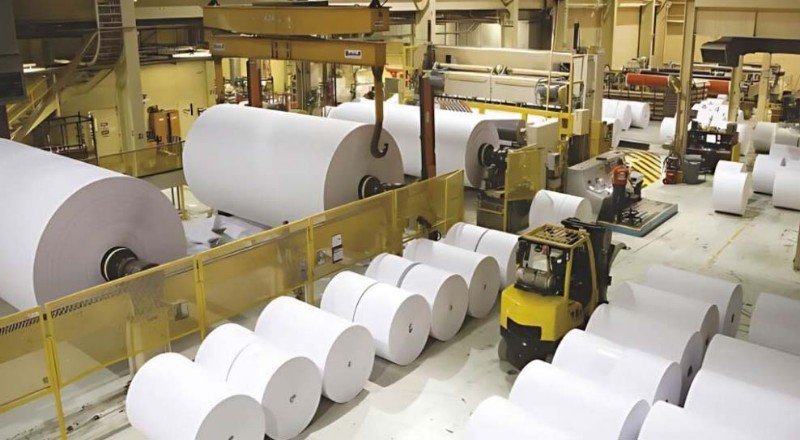
Photo: Collected
Bangladesh’s paper industry is facing a multifaceted crisis, with rising production costs, energy shortages, escalating raw material prices, high interest rates, weakening domestic demand, and the import of finished paper at artificially low prices through under-invoicing pushing local manufacturers to the brink.
Industry stakeholders say the government is losing substantial revenue while domestic paper mills are struggling to survive due to unfair competition from low-priced imports.
According to the Bangladesh Paper Mills Association (BPMA), nearly Tk1 trillion (around Tk100,000 crore) has been invested by the private sector in the country’s paper industry over the past two decades. The sector directly employs around one million people, while the livelihoods of nearly five million more depend on it indirectly. Bangladesh currently has around 100 paper mills of varying sizes.
These mills have a combined annual production capacity of approximately 1.5 to 1.6 million metric tonnes, whereas the country’s annual demand stands at around 900,000 metric tonnes. This leaves an excess production capacity of nearly 700,000 metric tonnes. However, most mills are unable to operate at full capacity due to sluggish domestic demand and the influx of low-priced imported paper.
To address the situation, BPMA Secretary AKM Nausherul Alam has written to the Chairman of the National Board of Revenue (NBR) and the Secretary of the Internal Resources Division.
The association has urged the government to fix the minimum customs assessment value for imported finished paper at $945 per metric tonne in order to protect domestic industries, preserve employment and safeguard government revenue. It has also called for a ban on the import of 29.5-inch paper rolls, 20- or 30-sheet, 70 or 80 GSM off-white natural shade printing paper manufactured according to the specifications set by the National Curriculum and Textbook Board (NCTB).
Eighty mills shut, 26 more at risk
According to the BPMA, 80 paper mills have already ceased operations due to cheap imports, while another 26 are at risk of closure.
As a result, the jobs of nearly one million workers and employees have become uncertain.
The association also says the government is losing revenue while fresh investment in the sector is being discouraged.
Speaking on the issue, Mohammad Iarul Islam Bidyut, Senior General Manager (Marketing) of Meghna Pulp and Paper Mills Ltd, said, “We have held meetings with the Education Minister and the Education Secretary regarding the NCTB’s paper demand and supply. During those meetings, we clearly stated that if the necessary policy and financial support is provided, the country’s writing and printing paper mills will be able to supply all the paper required by the NCTB within the stipulated timeframe.”
He said that around 30 writing and printing paper mills are currently operating in Bangladesh and that their combined production capacity far exceeds domestic demand.
“If the supply of raw materials, working capital and appropriate policy support are ensured, domestic mills will be able to operate at full capacity and Bangladesh could eventually export paper to international markets,” he added.
Bidyut further said that many local manufacturers have already imported large quantities of pulp and completed the necessary investments in preparation for supplying paper to the NCTB.
“If finished paper is now imported from abroad, the raw materials, investments and production plans of these companies will face significant risks. A vested interest group is actively lobbying in favour of importing paper. Such unnecessary imports will force many factories to reduce production or shut down altogether, threaten the jobs of thousands of workers, discourage domestic investment and increase unnecessary expenditure of foreign currency,” he said.
He added, “To protect local industries, preserve employment, save foreign exchange and build a self-reliant Bangladesh, the government should give the highest priority to the domestic paper industry and discourage paper imports unless absolutely necessary.”
How can pulp be assessed at $840 while finished paper is assessed at $600?
Mustafizur Rahman, Senior Deputy Managing Director of Bashundhara Group, questioned the disparity in customs valuation.
“At present, pulp—the principal raw material for paper production—has to be imported entirely from abroad. Previously, Bangladesh produced pulp from bamboo and timber, but shortages of raw materials have made the industry completely dependent on imports,” he said.
“Although the customs assessment value of imported pulp is $840 per tonne, many importers declare the value of finished paper at only $600 per tonne through under-invoicing. This has placed domestic manufacturers under severe competitive pressure and is leading to the closure of paper mills one after another.”
Rahman said the Bangladesh Paper Mills Association has formally raised the issue with the government and submitted letters to both the Ministry of Commerce and the Chairman of the National Board of Revenue.
“The association is coordinating the matter on behalf of the industry,” he added.
He further argued that since the assessment value of pulp is $840 per tonne, the customs assessment value of finished paper should include processing costs and be increased by at least another $200, bringing it close to $1,000 per tonne.
“We are not demanding a ban on paper imports. We simply want a fair and level playing field,” he said.
Industry vital to multiple sectors
Analysts say the paper industry is not merely a manufacturing sector but a critical foundation for education, publishing, pharmaceuticals, food processing, packaging and the ready-made garment industry.
A weakened paper industry would therefore have adverse effects on investment and employment while increasing the country’s future dependence on imports.
They believe that curbing under-invoicing, ensuring fair customs valuation, promoting healthy competition and providing necessary policy support would enable Bangladesh’s paper industry not only to meet domestic demand but also to emerge as a significant export-oriented sector in the future.