Weekly Bangla Mirror | Bangla Mirror, Bangladeshi news in UK, bangla mirror news

Experts have emphasised that the use of low-carbon construction materials is essential in Bangladesh’s housing and commercial building sectors to address the challenges posed by rapid urbanisation and ongoing development.
They stressed the importance of reusing existing materials, adopting low-carbon alternatives, and ensuring the use of renewable energy at every stage of infrastructure development, from design to implementation, said a press release.
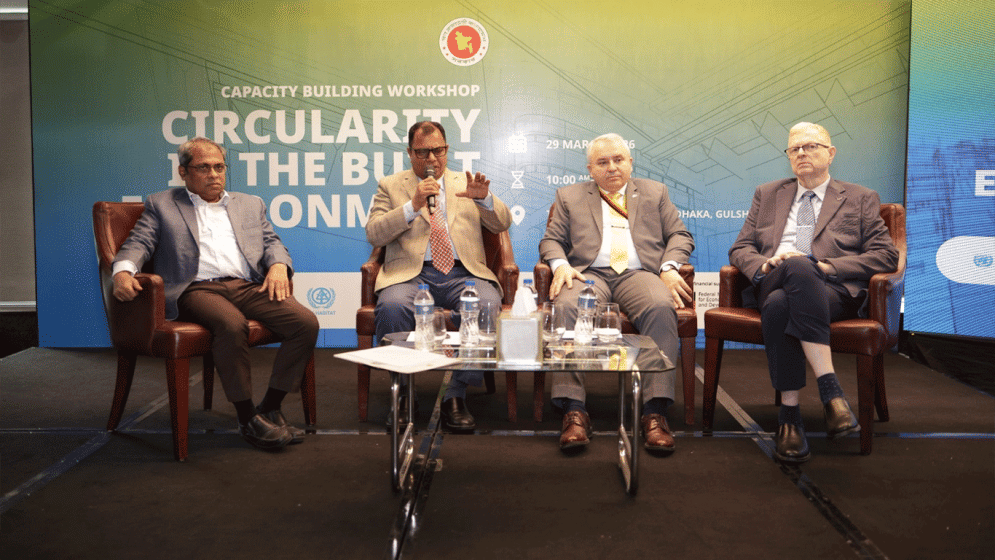
These observations were made at a workshop titled “Circularity in the Built Environment” held at a hotel in the capital on Sunday.
The workshop focused on assessing the current situation and identifying future directions for sustainable and resource-efficient construction practices in Bangladesh. The main objective of the event was to promote and implement sustainable and resource-efficient construction methods in the country’s building sector.
The workshop was organised by the Ministry of Housing and Public Works with support from the United Nations Environment Programme (UNEP), the United Nations Office for Project Services (UNOPS), and UN-Habitat.
The initiative is part of a major project funded by the German Federal Ministry for Economic Cooperation and Development, aimed at transforming Bangladesh’s construction sector through the adoption of sustainable building materials.
Speakers at the workshop highlighted the importance of promoting circular economy principles to reduce carbon emissions, ensure efficient use of resources, and accelerate climate-resilient construction practices. They noted that circularity has already gained popularity in many developed countries as an effective strategy for sustainable development.
Chairman of the project’s Technical Committee and Additional Secretary of the Ministry of Housing and Public Works, Md Sarwar Alam, said the construction sector is one of the key drivers of Bangladesh’s development, playing a vital role in housing and public infrastructure development.
However, he noted that it is also one of the most resource-intensive sectors with significant environmental impacts.
He further stated that Bangladesh is undergoing rapid urbanization, which will significantly increase the demand for construction materials in the coming years.
Continuing with conventional construction practices, he warned, would put immense pressure on natural resources and increase waste and carbon emissions.
Describing the country’s future infrastructure development needs as a “unique opportunity,” he said Bangladesh has the chance to choose a sustainable and low-carbon development path.
He added that circular construction practices could ensure efficient use of materials, reduce waste, and enhance the durability of infrastructure.
Highlighting government initiatives, he said a National Green Building Certification System is being developed with the support of the Housing and Building Research Institute, while the Public Works Department is working on proposals to include low-carbon materials in its official rate schedules.
Ulrich Kleppmann, head of Development Cooperation at the German Embassy, said the construction sector plays a major role globally in carbon emissions, waste generation, and resource consumption. Moving towards circularity in the built environment, he said, is not only an environmental necessity but also a significant economic opportunity.
Referring to Germany’s experience, he noted that transitioning to a circular economy requires more than goodwill—it demands systemic change in how infrastructure is designed, constructed, used, and eventually recycled.
He added that through innovation, appropriate regulatory frameworks, and collaboration among policymakers, private developers, and academia, it is possible to build a sector that is not only low-carbon but also more resilient and efficient.
Sudhir Muralidharan, country manager of UNOPS for Bangladesh and Bhutan, said reuse is not a new concept in Bangladesh but rather part of its tradition. For generations, people have demonstrated how materials can be carefully reused, he said, adding that this mindset now needs to be integrated into modern construction practices.
He also noted that many buildings constructed during the 1970s and 1980s are now aging and could generate significant waste. If not properly managed, this could become a major environmental challenge.
However, he described the situation as an opportunity rather than a crisis, suggesting that with data-driven planning, reuse of materials, standard setting, and demonstration projects, Bangladesh could turn waste into valuable resources.
The workshop was also attended by UNDP Bangladesh Resident Representative Stefan Liller, UNOPS Bangladesh and Bhutan Country Manager Sudhir Muralidharan, Director General of the Housing and Building Research Institute Mohammad Gias Uddin Haider, along with senior government officials, private sector representatives, university teachers, and researchers.
Participants emphasised the need for stronger collaboration among government agencies, the private sector, and academia to ensure sustainable and resilient infrastructure development. They also highlighted the urgency of taking effective measures to address the environmental impacts of rapid urbanisation in Bangladesh.
Speakers further stressed that circular construction practices could serve as a strategic pathway to reduce the use of construction materials and minimise environmental pressure. Several case studies were presented to demonstrate how evolving infrastructure design approaches are enabling sustainable construction with fewer resources.
A panel discussion titled “How to Institutionalize the Circular Economy in Bangladesh’s Built Environment” was also held, with participation from stakeholders including RAJUK and PKSF.
Experts recommended integrating low-carbon materials into the construction sector, strengthening green building frameworks, and aligning the sector with Bangladesh’s national climate commitments, including upcoming Nationally Determined Contribution (NDC) targets.