Weekly Bangla Mirror | Bangla Mirror, Bangladeshi news in UK, bangla mirror news
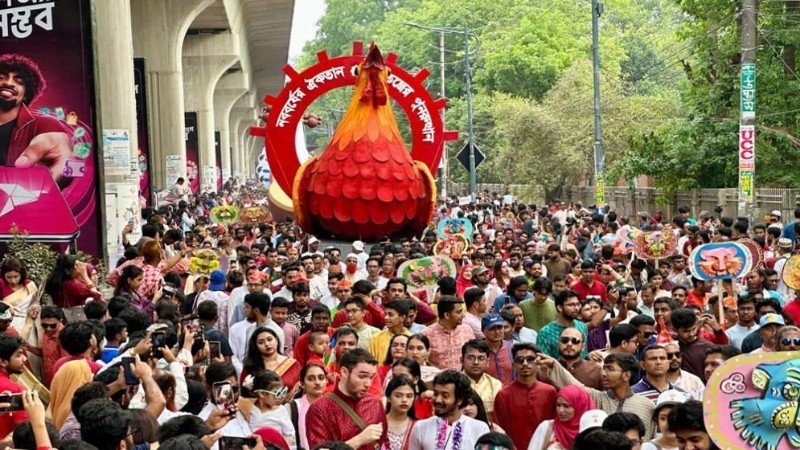
Thousands of people joined the traditional Baisakhi Shobhajatra to celebrate the Bengali New Year 1433, as it began from the Faculty of Fine Arts at Dhaka University on Tuesday.
The colourful procession started at around 9:00 am and drew enthusiastic participation from people of all ages and professions, including students and teachers, creating a festive atmosphere across the campus.
New Year celebrations began early in the morning at Ramna Batamul, where a cultural programme opened at sunrise with a collective rendition of “Jago Alok-Lagane.” A total of 22 performances were presented during the two-hour programme, which concluded with the national anthem before participants prepared for the Shobhajatra.
This year’s Shobhajatra carried the theme “New Year’s Harmony, Democracy’s Resurgence.” The procession started from the northern gate of the Faculty of Fine Arts, passed Shahbagh Police Station, made a U-turn, and moved through key points including Raju Sculpture, Doel Square, and Bangla Academy before returning to its starting point.
Five main motifs—rooster, elephant, pigeon, dotara, and horse—featured prominently, alongside representations of fish, tiger and deer cubs, goats, cockatoos, and peacocks.
Each motif carried symbolic meaning: the rooster represented new beginnings and awakening; the dotara reflected folk traditions and cultural roots; the elephant symbolised strength and heritage; the horse evoked rural simplicity and childhood memories; and the pigeon conveyed harmony and peace.
Participants also protested attacks on Baul communities and reaffirmed their commitment to building a culturally inclusive Bangladesh.
The presence of diverse groups added to the vibrancy and spirit of the event.
The Shobhajatra, long regarded as a symbol of the non-communal cultural heritage of Bengalis, was previously known as Ananda Shobhajatra and Mangal Shobhajatra. It was recognised by UNESCO as an Intangible Cultural Heritage of Humanity in 2016.
Law enforcement agencies maintained strict security across the campus. Members of police, RAB, DB, and SWAT were deployed in and around the Faculty of Fine Arts, while additional measures—including searches, barricades, controlled entry, and enhanced CCTV surveillance—ensured safety throughout the programme.