Weekly Bangla Mirror | Bangla Mirror, Bangladeshi news in UK, bangla mirror news
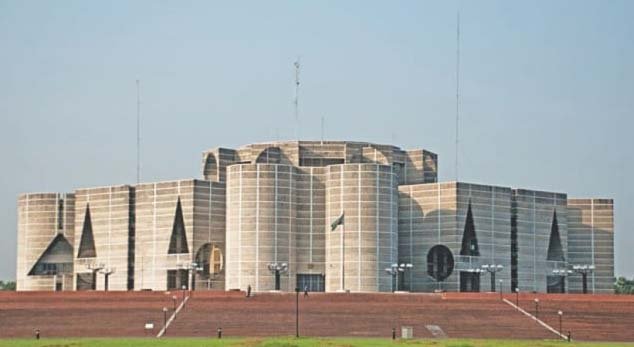
File Photo
Jatiya Sangsad (JS) on Tuesday passed a Tk 9,38,000 crore national budget for the fiscal year 2026-27.
The budget for next fiscal set targets to accelerate economic growth to 6.5 per cent and bring inflation down to 7.5 per cent.
This was the maiden budget for the Finance Minister after BNP formed the government this time following a victory on February 12 general election.
A BNP-led government had last presented its national budget for the fiscal year 2006-07 under the then Finance Minister M. Saifur Rahman, reports BSS.
The budget for FY27, the first presented by Finance Minister Amir Khasru Mahmud Chowdhury, is 19 percent larger than the original Taka 7,90,000 crore budget for the current fiscal year.
The fiscal deficit has been projected at Taka 2,43,000 crore, equivalent to 3.6 per cent of the country’s gross domestic product (GDP), while the overall budget size represents 13.7 percent of the projected GDP for FY2026-27.
As part of the government’s economic roadmap, the finance minister unveiled a “3R Strategy” aimed at reviving the economy and supporting Bangladesh’s ambition of becoming a US$1 trillion economy.
The strategy comprises Recovery and Stabilisation, Restoration, and Reconstruction for Acceleration, and will be implemented in three phases over a period of one to five years.
Key features of the budget include a revenue collection target of Tk 6,95,000 crore, of which the National Board of Revenue (NBR) is expected to collect Taka 6,04,000 crore.
To facilitate implementation of the budget, Finance Minister Amir Khasru Mahmud Chowdhury moved the Appropriation Bill, 2026, today seeking authorisation for government expenditure amounting to Taka 15,15,439 crore.
Earlier on Monday, the Parliament passed the Finance Bill, 2026 with several significant amendments, including raising the tax-free income threshold and abolishing the provision requiring disclosure of investments.
Before passage of the Appropriation Bill, ministers concerned presented justifications for expenditure under their respective ministries through 59 demands for grants covering both development and non-development spending.