Weekly Bangla Mirror | Bangla Mirror, Bangladeshi news in UK, bangla mirror news
Collected Photo
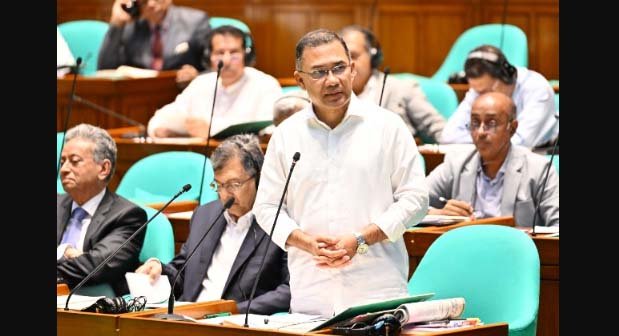
Prime Minister Tarek Rahman has said the government is implementing a multi-pronged and coordinated plan to overcome the country’s energy crisis and build a self-reliant and sustainable energy system.
Speaking in Parliament on Wednesday in response to questions from lawmakers, he said strengthening energy security, increasing the use of renewable energy and reducing dependence on imports were among the government’s priorities.
In response to a question from lawmaker Selina Sultana, the Prime Minister said increasing domestic gas production had been given the highest priority.
Under a programme to drill and overhaul 150 wells, work on 30 wells has already been completed, adding 140 million cubic feet per day (MMCFD) of new gas to the national grid. Work on seven more wells is underway, which is expected to add another 85 MMCFD when completed.
To intensify gas exploration, the government is also implementing plans for 4,500 line-km of 2D and 4,200 square-km of 3D seismic surveys. The process of purchasing two modern rigs to strengthen state-owned Bangladesh Petroleum Exploration and Production Company (Bapex) is also at the final stage.
The Prime Minister said extensive exploration was underway under offshore and onshore production sharing contracts (PSCs) to ensure long-term energy security.
He said an international bidding round had been invited following approval of PSC-2026, while the approval process for the onshore model PSC was at the final stage.
The government is also working to increase LNG import capacity. Discussions are underway with an international company to establish a new floating LNG terminal at Kutubjom in Maheshkhali, Cox’s Bazar.
The terminal is expected to provide an additional 600 MMCFD of regasified LNG by December 2028. Feasibility studies are also underway for setting up one or two more floating LNG terminals in the southwestern region, including around Payra and Mongla ports.
On renewable energy, the Prime Minister said duties and taxes on solar panels, inverters, batteries and other necessary equipment had been withdrawn to encourage the sector.
He said the government would purchase surplus electricity generated by rooftop solar systems installed at homes and institutions over the next six months at Tk10.15 per unit.
A national rooftop solar programme has also been undertaken to install solar panels at government buildings, educational institutions and hospitals. Rooftop solar systems have already been installed at the offices of all deputy commissioners and divisional commissioners.
The government is also advancing integrated plans to generate electricity from wind, hydropower and waste.
The Prime Minister said these initiatives were part of the government’s broader efforts to strengthen energy security and build a sustainable energy system.