Weekly Bangla Mirror | Bangla Mirror, Bangladeshi news in UK, bangla mirror news

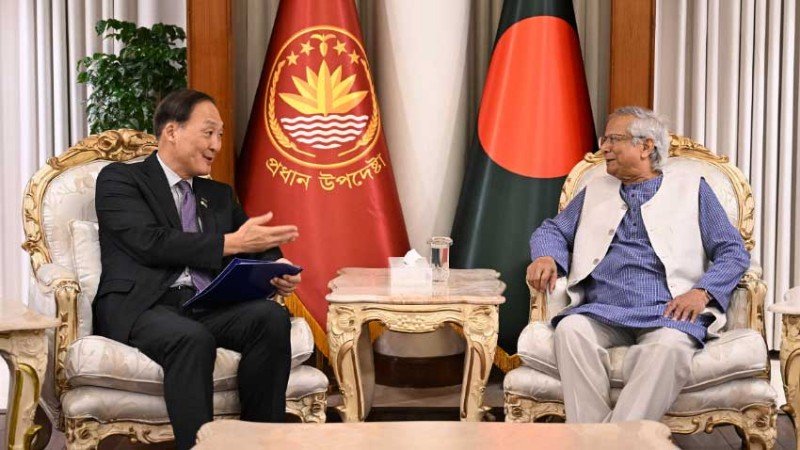
Chief Adviser Professor Muhammad Yunus and Korea International Cooperation Agency (KOICA) President Chang Won-sam held a high-level discussion in Dhaka on Monday, focusing on strengthening development partnerships, expanding investment opportunities, and enhancing human capital to support Bangladesh’s transition from Least Developed Country (LDC) status.
The meeting took place at the State Guest House Jamuna, where Chang conveyed warm greetings from the government of South Korea and expressed his pleasure at returning to Bangladesh. He reaffirmed KOICA’s continued political endorsement of the interim government as well as its reform-driven agenda.
Chang underlined Korea’s long-standing development relationship with Bangladesh, noting KOICA’s readiness to support the country’s LDC graduation process through targeted development assistance, expanded skills-training initiatives, and investment-driven partnerships.
He praised the interim government’s focus on economic reforms, governance improvements, and human resource development, adding that KOICA sees Bangladesh as an increasingly important partner in South Asia.
Prof Yunus welcomed the KOICA delegation and outlined the government’s broader economic vision, highlighting Bangladesh’s aspiration to position itself as a regional production hub. He encouraged Korean investors, manufacturing companies, and educational institutions to build long-term partnerships that could benefit both nations.
“We want to become a production hub,” the Chief Adviser said. “We can produce your products here and sell them everywhere. We have the manpower, the capabilities, and a young workforce eager to work hard.”
He noted that Bangladesh’s demographic advantage, coupled with a rapidly expanding industrial base, presents meaningful prospects for Korean businesses looking to diversify supply chains or scale up production for global markets.
Prof Yunus stressed that sustainable development must be people-centered. He urged KOICA to expand Korean language training programmes in Bangladesh, which would enhance opportunities for Bangladeshi youth seeking higher education, technical training, or employment in Korea.
He pointed out that language proficiency can significantly boost the competitiveness of migrant workers and students, making cooperation in this sector essential for strengthening bilateral labour mobility.
The Chief Adviser also highlighted the urgent need for enhanced collaboration in healthcare training, particularly for nurses and medical support staff.
“It is very crucial for our healthcare system and for global healthcare,” he said. “We need to focus more on training nurses.”
He emphasized the growing global shortage of trained nurses and healthcare professionals, suggesting that Bangladesh could play a significant role in supplying skilled workers to international markets through high-quality training programmes supported by KOICA.
Responding to the Chief Adviser’s proposals, KOICA President Chang expressed strong interest in expanding cooperation in skills development, education, and technical training. He noted that KOICA is keen to support programmes that align with Bangladesh’s economic priorities and contribute to the country’s LDC graduation strategy.
He also assured that the agency would explore new areas of collaboration that could strengthen institutional capacity and promote sustainable development.
Chief Adviser’s Special Envoy for International Affairs Lutfey Siddiqi and SDGs Affairs Principal Coordinator and Senior Secretary Lamiya Morshed were present during the discussions, underscoring the government’s commitment to deepening ties with South Korea at a strategic level.
Both sides agreed to maintain close communication as Bangladesh pushes forward with its transition agenda, focusing on reforms, international cooperation, and human resource development as key drivers of future growth.