Weekly Bangla Mirror | Bangla Mirror, Bangladeshi news in UK, bangla mirror news
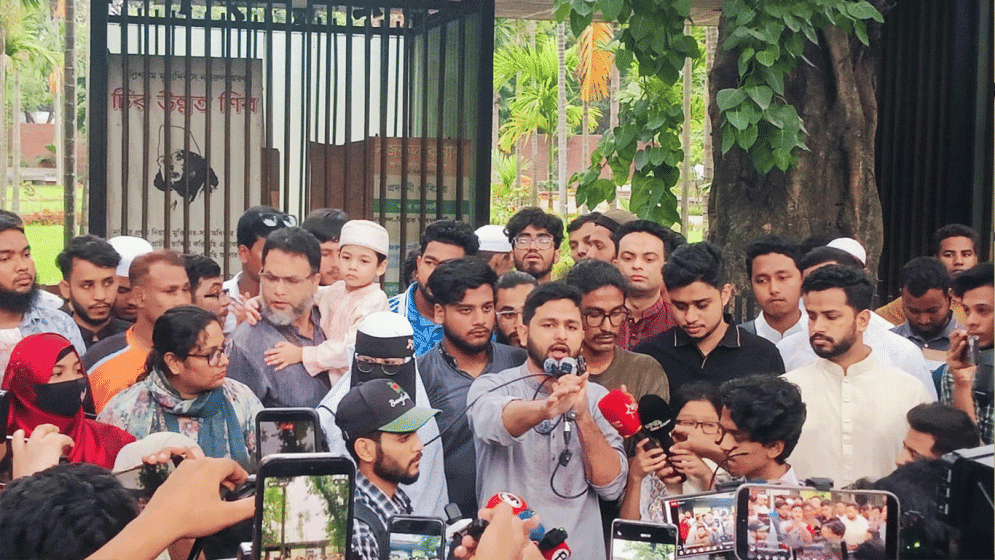
Inqilab Moncho held a protest march on Friday demanding that the authorities identify the killers of Sharif Osman bin Hadi, repatriate the fugitive suspects, and ensure swift justice.
The organisation also demanded a full investigation into the murder, alleging Indian involvement in the crime.
During the march, Inqilab Moncho issued a seven working day ultimatum to the government to provide specific information regarding the killers.
The group announced that if the government fails to provide detailed information or a clear trial deadline by next Friday, it will launch again a public sit-in programme at Shahbagh.
The protest march began at the Dhaka University Central Mosque after Friday prayers, marched the Shahbagh intersection, and concluded on the road in front of Osman Hadi’s grave.
Following the march, Abdullah Al Jaber, member secretary of Inqilab Moncho, criticised the administration’s slow progress.
“It has been three months since the elected government came to power,” Jaber said. “So far, the government has not been able to formulate any specific outline for the trial of Osman Hadi. The government is repeatedly saying that the process of bringing back the killer is underway. We want to know whether this process will continue until the end of time.”
Jaber argued that the foreign ministry should have investigated statements made by West Bengal Chief Minister Mamata Banerjee regarding the case.
He expressed frustration that the State Minister for Foreign Affairs dismissed Banerjee’s remarks as those of a “defeated candidate.”
He stated that Inqilab Moncho will no longer issue minor ultimatums, leaving it to the government to set specific deadlines.
“Firstly, there was supposed to be an investigation under the UN,” Jaber said, outlining his two primary demands.
“We want to hear from the government whether the UN has agreed to the investigation or whether they have prohibited it. Secondly, it is clear from Mamata Banerjee’s statement that India and Bangladesh are linked to Hadi’s murder. Therefore, I think the government should take full control and take steps to complete the trial of this murder as soon as possible.”
Jaber also criticised State Minister for Foreign Affairs Shama Obaed’s recent speech.
“Personally, we like her, but we did not see any strong position in favour of Bangladesh’s interests in her speech,” he remarked.
“Even after West Bengal Chief Minister Mamata Banerjee of India released such important information, our Minister of State for Foreign Affairs did not consider it necessary to take the matter into consideration. This is very sad.”
He questioned the lack of visible progress despite official claims that India had agreed to extradite the killers, asking, “What is the specific timeframe for bringing them back? Or will this process continue indefinitely?”
Masudur Rahman Adnan, a central member of the organisation, added, “This government assured the Inqilab Moncho after coming to power that we are committed to the trial of Osman Hadi, but even after three months of their government functioning, there has been no visible role in this regard. To stop the culture of impunity, it is very important to ensure a speedy and impartial trial of this murder.”
Meanwhile, Masuma Hadi, the sister of the deceased, raised public questions via Facebook regarding why Abdullah Al Jaber is acting as the plaintiff in her brother’s murder case.
Expressing distress over social media rumours, Masuma questioned why the administration took Jaber’s signature at Evercare Hospital while she was present, and without consulting her. She recalled that Osman’s brother, Omar Farooq, who survived the shooting alongside Osman on the same rickshaw, was entirely focused on securing medical treatment at the time.
Masuma revealed that Omar initially spent Tk52 lakh from his personal funds to arrange emergency medical transport to Thailand after Singapore initially rejected the medical documents. The government later intervened, resubmitted the documents to Singapore successfully, and took over the treatment responsibilities.
“If Jaber was not my stepfather’s son, there was no question,” Masuma wrote, emphasising her own close relationship with her brother.
“Without coming to that younger sister, with whose permission Jaber filed the case, this must be clarified.”
She concluded by criticising those who spread misinformation about the family on social media, stating, “You can’t respect him, but where did you get the right to disrespect him without knowing anything.”