Weekly Bangla Mirror | Bangla Mirror, Bangladeshi news in UK, bangla mirror news

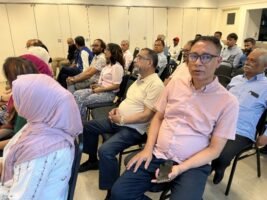
London, 21 June: Prominent academics, legal experts and political commentators gathered in East London on 21 June for a seminar examining Bangladesh’s political and social landscape following the dramatic political developments of August 2024.
Titled “From Uprising to Uncertainty: Bangladesh Post-August 2024 Political and Social Landscape,” the event was jointly organised by five international and European organisations and brought together speakers from Bangladesh, Europe and the United States.
Among the keynote speakers were noted journalist and author Syed Badrul Ahsan, Barrister Tania Amir of the Supreme Court of Bangladesh, and Professor ABM Nasir from the United States.
Opening the seminar, Professor Nasir presented his analysis of the July-August 2024 political movement, arguing that the removal of the Awami League government was linked to a long-term political strategy that originated in the early 2000s. He contended that a coalition involving elements of civil society, sections of the media, Islamist groups and foreign actors played a role in reshaping Bangladesh’s political trajectory.
Professor Nasir said several developments surrounding the 2024 unrest warranted further investigation, including attacks on police and security installations, damage to cultural and historical sites associated with the Liberation War, prison breaks involving convicted militants, and the re-emergence of political actors previously sidelined because of their links to anti-Liberation War politics. He argued that the movement sought not only political change but also a re-evaluation of Bangladesh’s post-independence political narrative and called for an independent inquiry into the planning, implementation and consequences of the 2024 political transition.
Barrister Tania Amir focused on what she described as the shortcomings of successive pro-liberation governments in safeguarding the ideals of the Liberation War. She criticised policies toward radical Islamist groups, arguing that they had enabled the growth of extremist elements. She also questioned the legal and constitutional basis of the Interim Government’s proposal to hold a referendum.
Addressing the audience, Syed Badrul Ahsan reflected on what he described as recurring political intrigues that have periodically challenged Bangladesh’s democratic institutions and founding principles. Drawing parallels between the events of August 1975 and August 2024, he expressed concern over the apparent inability of intelligence agencies to anticipate efforts aimed at removing constitutionally elected governments.
Syed Badrul Ahsan was critical of the administration led by Nobel laureate Muhammad Yunus, alleging that it had committed serious violations and should face legal accountability under a future elected government. He also urged the Awami League to develop a comprehensive strategy for reviving what he termed the “Spirit of 1971,” and stressed the need for a strong second tier of leadership within the party.
The seminar was jointly organised by the European Bangladesh Forum, the South Asia Democratic Forum (Brussels), the AK-BiN Working Group Bangladesh (Germany), the Earth Civilisation Network (Türkiye), and the Freedom and Justice Alliance (Global Platform).
Organisers said the event aimed to encourage discussion and critical examination of the political, constitutional and social changes that have unfolded in Bangladesh since August 2024.