Weekly Bangla Mirror | Bangla Mirror, Bangladeshi news in UK, bangla mirror news
By Matiar Chowdhury:
Sipahsalar Syed Nasir Uddin—one of the 360 *Awliya* (saints) accompanying
Hazrat Shah Jalal (RA)—is an unforgettable name in the history of Sylhet.
Following the conquest of Sylhet in 703 Hijri, twelve *Awliya* (saints), led
by Sipahsalar Syed Nasir Uddin, defeated the tyrannical King Achak
Narayan of Taraf and conquered the kingdom of Taraf. The shrine of
Syed Nasir Uddin—the capital of the former Taraf Kingdom—is located
at Murarband Dargah in the Chunarughat Upazila of the present-day
Habiganj district. The Murarband Dargah Sharif houses the shrines of 120
*Awliyas* (saints), including Sipahsalar Syed Nasir Uddin. Legend has it that
when Sipahsalar Syed Nasir Uddin set out from home, his mother
blessed him, saying that wherever he went, he would fare well, and his
descendants would spread across the globe like the stars in the
sky—casting a radiant light upon the world. The impact of the prayers of
this spiritually accomplished woman is being witnessed in present times.
Syed Shah Wali Ullah (Rah.) is the progenitor of the Syed family of Jahirpur. He
was the 15th-generation descendant of Syed Nasir Uddin, the commander who
conquered Taraf. He moved from Faridpur in the Kursha Pargana to Atowajan
Pargana and settled there. He was an accomplished *Fakir* (spiritual ascetic).
His father's name was Syed Shah Karam Muhammad. Acting on their father's
instructions, the three sons of Syed Shah Karam Muhammad set out from
Faridpur to various parts of the country with the aim of propagating the faith.
Syed Shah Sikandar (Rah.), the eldest son of Syed Shah Karam Muhammad,
moved to Guldoba village in the Agna Pargana of present-day Nabiganj Upazila;
the presence of his descendants can be found there. The second son, Syed
Shah Wali Ullah (RA), moved to Jahirpur in the Atoajan Pargana of
Jagannathpur Upazila, in the present-day Sunamganj district. All members of
the current generation of the Syed family in Jahirpur village are descendants of
Syed Shah Wali Ullah (Rah.), who belonged to the lineage of Syed Shah Sheikh
Farid—himself a descendant of Sipahsalar Nasir Uddin. The third son, Syed
Shah Ahmad (Rah.), moved to the Sirajdikhan area of Bikrampur; his
descendants still reside there.
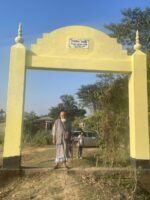
Photo No. 1: The gate of the house built by the current generation at the Syed family home in
Jahirpur.
Descendants of Sipahsalar Syed Nasir Uddin can be found throughout
Bangladesh as well as in West Bengal. More than a hundred families belonging
to his lineage reside in Sylhet, Brahmanbaria, and Comilla—particularly in the
Shayestaganj and Chunarughat upazilas of Habiganj. There are over a hundred
more families in Bahubal, Nabiganj, Madhabpur, Nasirnagar, Akhaura, and
Kishoreganj. All the Sayyids of the villages nestled against the Raghunandan
hills—namely Narapati, Sultansi, Daudnagar, Lashkarpur, Faridpur, and
Surabai—are descendants of this Nasir Uddin. They are scattered across the
entire country, not just in Habiganj or Brahmanbaria. Descendants of
Sipahsalar Nasir Uddin can be found in several villages, including Enatabad and
Guldoba in Nabiganj. Writers and historians have written extensively on this
subject over the years. Evidence of this can be found in the northern and
eastern sections of *Srihatter Itibritta*—the only authoritative text on the
ancient history of Sylhet—authored by Achyut Charan Chowdhury Tattvanidhi
(1910–1917) and published by Saraswati Library, Silchar. Published by the
Bangla Academy in *Jalalabad-er Katha* and various issues of the monthly *Al-
Islah* (1936–1948).
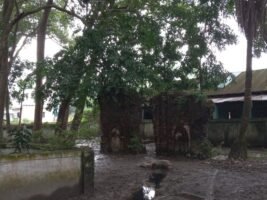
Photo No. 2: Ruins of the first mosque built by Sipahsalar Syed Nasir Uddin—the conqueror of
Taraf—at the Murarband Dargah Sharif.
According to Syed Murad—the current Mutawalli of Murarband Dargah Sharif
and a descendant of Sipahsalar Syed Nasir Uddin—the roots of all the
descendants of Sipahsalar Nasir Uddin lie in Murarband. The process of
relocation began from Murarband. Initially, people moved from Murarband to
places such as Laskarpur, Ramshri, Khandura, Suraboi, Sultansi Daudnagar, and
Sylhet city. Subsequently, they moved from those locations to settle in various
other places. Members of this lineage have migrated to different parts of the
country throughout the ages, and this trend continues to this day.
No matter where anyone has gone, the histories of all the families are
preserved within the Murarband Syed family. The veracity of Syed Murad’s
statements can be found in Achyut Charan Chowdhury’s (Tatthanidhi)
*Srihatter Itibritta* (published between 1910 and 1917)—specifically in the
section regarding the origins of the Taraf and Syed lineages (within the first
part of the work), and in the chapter detailing the Taraf lineage (pages 152,
154, 160, and 162). In this regard, he mentions that Syed Shah Sikandar—son
of Syed Shah Karam Muhammad of the Faridpur branch—went to Guldoba and
settled there. Another son, Syed Shah Wali Ullah, moved to the Atoyajan Pargana.
(R)—brother of Syed Shah Wali Ullah (R)—in Guldoba village.
According to the *Nasabnama* (genealogical record) preserved at Murarband
and information provided by historians, Syed Musa moved from Murarband to
Laskarpur and settled there. Thus, Syed Musa is the founder of the Syed family
of Laskarpur.
Musa's son was Syed Adam, and Adam son was Syed Quddus.
Quddus's son was Syed Ala Uddin; Syed Ala Uddin had two sons, Syed
Hasan and Syed Farid. All the Sayyids of present-day Laskarpur are
descendants of Sayyid Hasan. Sayyid Farid moved to Kursha Pargana and
settled there; the village was named Faridpur after him. According to
researchers Syed Mohammad Iliyas and Dewan Nurul Anwar Hussain
Chowdhury—who specialize in the study of Achyuta Charan Chowdhury
Tattvanidhi and Syed Nasir Uddin—Syed Farid founded the village of Faridpur.
Syed Farid had three sons: 1. Syed Rehan, 2. Syed Sultan, and 3. Syed Manwar.
Syed Rehan’s son was Syed Enayet Ullah, and Syed Sultan’s son was Syed
Karam Muhammad. Syed Manwar’s son was Syed Amir Ali. (The descendants
of Syed Amir Ali reside in Kasim Nagar in the present-day state of Tripura.)
Syeda Kalabibi was the daughter of Syed Enayet Ullah—a figure frequently
mentioned by the historian Achyutacharan Chowdhury in his writings. Syed
Shah Karam Mohammad had three sons: Syed Shah Sikandar, Syed Shah Wali
Ullah, and Syed Shah Ahmad; the descendants of Syed Shah Sikandar branched
out into various lineages and currently reside in Guldoba village of Nabiganj
Upazila. The descendants of Syed Shah Wali Ullah reside in Jahirpur village
within the Asharkandi Union of the present-day Jagannathpur Upazila—a place
known as Jahirpur Syedbari. Descendants of Syed Shah Ahmad—son of Syed
Shah Karam Muhammad—also reside in the Sirajdikhan Upazila of Nawabganj,
near Dhaka.
who was the worthy successor of Sipah Salar Syed Shah Nasir Uddin (RA)—located in Faridpur
village.
While shedding light on Syed Rajawar Rahman—the first Munsif of
Nabiganj—Achyut Charan Chowdhury stated that Riyazur Rahman, son of
Motiur Rahman (a resident of Taraf Pargana), married Kalabibi—the daughter
of Syed Enayet Ullah—and thereby acquired the rights to Mahals No. 3 and No.
- Riazur Rahman and his brother received *Chaudhuri* and *Kanungo*
sanads. Riazur Rahman's son, Raozawar Rahman, founded the village of
Rajapur; this Rajapur is located in the Murshidabad district of West Bengal. He
pursued his education in Calcutta. There, he became acquainted with the then
Governor-General and Cabinet member, the honorable Mr. Martin. With Mr.
Martin's assistance, he was appointed as the Munsif of Nabiganj. He passed
away at the age of 85 in the year 1276 BS. This account by Achyuta Charan
Chowdhury—originally from *Srihatter Itibritta* (Volume II, p. 60)—was
published in *Nabiganjer Itikatha* by Matiyar Chowdhury (First Edition, 1985;
see p. 65).

Photo No. 5: Syed Shah Sikandar (R.)—brother of Syed Shah Wali Ullah (R.)—is laid to rest here in
Guldoba village.
Sources: *Srihatter Itibritta: Uttarangsha-Purbangsha* by Achyut Charan Chowdhury
Tattvanidhi (1910–1917); *Sipahsalar Syed Nasir Uddin* (Volumes I & II) by Syed
Muhammad Ilyas; *Nabiganjer Itikatha* by Matiyar Chowdhury (1985). *History of Taraf*
by Syed Abdul Agfar; *Monthly Al-Islah* (issues from 1936–1948); *Weekly Sylhet
Samachar* (serialized articles by Monir Uddin Chowdhury, 1981–1987); *The Syed
Family of Taraf: Volume I* by Mostafa Kamal (1979, pp. 78–79). Genealogical
records (*Nasabnama*) preserved by the Syed families of Murarband, Ramshri, and
Khandura; and centuries-old documents held by the descendants of Syed Shah
Sikandar (RA)—brother of Syed Shah Wali Ullah (RA)—in Guldoba village, Nabiganj.
Source: *Jalalabad-er Katha* by Dewan Nurul Anwar Hossain Chowdhury (Bangla
Academy, Dhaka).