Weekly Bangla Mirror | Bangla Mirror, Bangladeshi news in UK, bangla mirror news
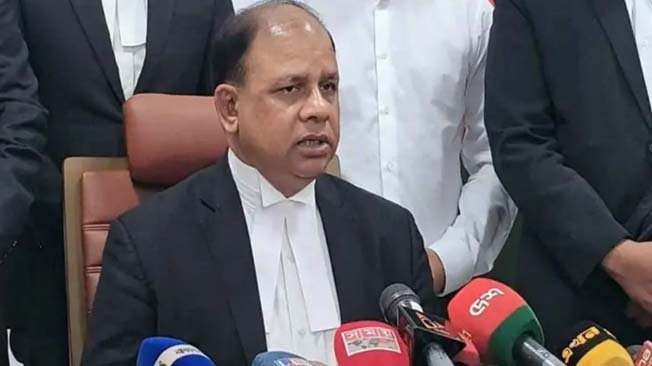
Photo: Collected
Fugitive death-row convict and former prime minister Sheikh Hasina can no longer file appeal against her sentence as the 30-day deadline has expired, said International Crimes Tribunal (ICT) Chief Prosecutor Md Aminul Islam on Monday.
The ICT-related act clearly states that a convict must file an appeal within 30 days of the verdict, and any plea afterwards would not be accepted, the chief prosecutor said.
The Section 21(3) of the “The International Crimes (Tribunals) Act, 1973” outlines the appeal deadline, he told reporters at a briefing held on the recently passed “The Enforced Disappearance Prevention and Redress Bill, 2026.”
Whether the convict is at prison or remains a fugitive is irrelevant – as per law, the individual has to file the appeal within 30 days of verdict at his/her own capacity or through others, Md Aminul Islam said.
The 30-day deadline applies to all convicts and sentenced individuals be it Sheikh Hasina of Awami League, now a banned political party, or Maulana Abul Kalam Azad of Jamaat-e-Islami, the chief prosecutor added.
On Monday, the Appellate Division of the Supreme Court was expected to hear a petition on accepting an appeal from death-row convict Maulana Abul Kalam Azad, who filed the plea almost 9,900 days after the ICT handed down the sentence in January 2013.
The Appellate Division deferred the hearing owing to deliberations over another “sensitive case.”
Journalists questioned the ICT chief prosecutor whether the Jamaat leader’s appeal petition so long after the 30-day deadline is acceptable, and whether Sheikh Hasina could seek to exploit the potential precedent.
The Chief Prosecutor said the law clearly rejects the prospects of accepting an appeal from Maulana Abul Kalam, but any authorised government in Bangladesh still reserves the right to suspend the sentence execution for a convict – a provision the Jamaat leader currently enjoys.
Maulana Abul Kalam Azad secured the sentence execution suspension during the interim government’s tenure, the chief prosecutor noted.
Any authorised government in Bangladesh has the inherent authority to suspend, reduce or permanently drop a sentence against any convict, the chief prosecutor added.
However, Hasina has no scope to pressure the BNP government into extending similar benefits for her, Md Aminul Islam clarified.
But Maulana Abul Kalam Azad secured the sentence execution suspension as a result of an “illegal move” from the then home ministry of interim government.
In response to a petition from the war crimes convict, the home ministry had set a condition that he must first agree to file an appeal petition before formally surrendering before the law, Md Aminul Islam said.
This condition contradicted and superseded the 30-day deadline under the “The International Crimes (Tribunals) Act, 1973,” something the home ministry simply could not do, the chief prosecutor said.
However, the interim government, by default, had every right to suspend the sentence execution in favour of Abul Kalam Azad, he added.
During the interim government’s tenure, Maulana Abul Kalam Azad sought pardon from the relevant department of the Supreme Court for his delay in seeking to file an appeal, and he had also asked for deferring the sentence execution until a potential appeal is disposed of.
In January 2013, the ICT sentenced him to death for alleged war crimes committed in 1971, the first sentencing in a case over crimes against humanity committed during the Liberation War of Bangladesh.