Weekly Bangla Mirror | Bangla Mirror, Bangladeshi news in UK, bangla mirror news
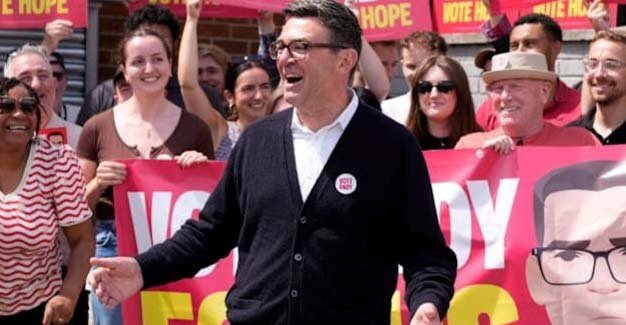
Labour candidate Andy Burnham gestures, surrounded by supporters at the Stubshaw Cross Community and Sports Club as voting is underway in the Makerfield by-election, in Ashton-in-Makerfield, England. (Collected Photo)
Andy Burnham is poised to become Britain’s next prime minister following Keir Starmer’s resignation, but analysts say he could find it difficult to quickly break away from the policies of his predecessor.
Burnham, the former mayor of Greater Manchester, was sworn back into Parliament just hours after Starmer announced he would step down on Monday. If no other candidate joins the Labour Party leadership race, Burnham is expected to take office on 17 July.
Although Burnham is one of Labour’s most popular figures and is known for his relaxed, approachable style, he will initially be bound by the party’s election platform that ended 14 years of Conservative rule in 2024.
Political analysts say his biggest task will be convincing voters that his leadership offers a fresh direction while maintaining confidence among financial markets.
“Andy Burnham is being seen by many as the person who can revive British politics,” said Matthew Flinders, a politics professor at the University of Sheffield. “The real test will come when expectations rise and public opinion becomes more demanding.”
Burnham is expected to outline his economic plans in a speech next week. His main priorities include boosting Britain’s sluggish economy, improving public services, tackling the cost-of-living crisis, increasing housing supply and creating more opportunities for young people.
Following Starmer’s resignation, Burnham said the country needed “stability” and a continued focus on issues that matter most to the public.
While Burnham is generally seen as more left-leaning than Starmer, he has promised not to exceed the government’s current spending and borrowing limits. Analysts say that approach is aimed at reassuring investors after the market turmoil triggered by former Prime Minister Liz Truss’ short-lived economic policies in 2022.
Burnham has promoted a model often described as “Manchesterism”, combining business-friendly policies with greater local control over housing, transport, education and public services. Reports suggest he may also move parts of the prime minister’s office away from London to northern England as part of his push to decentralise power.
He has ruled out raising income taxes and has suggested reducing some tax burdens on businesses. However, experts say questions remain over how he would finance new spending commitments while also meeting growing defence costs.
The outgoing government had pledged to increase defence spending to 3.5 per cent of GDP by 2035 to meet NATO targets, but critics argued progress had been too slow.
Foreign policy may also prove challenging for Burnham, who has little experience on the international stage.
Relations with US President Donald Trump could be particularly delicate. Trump recently dismissed Burnham as a “town” mayor and questioned whether he would support expanding North Sea oil drilling.
Unlike Starmer, who invested significant effort in maintaining ties with Washington and strengthening European support for Ukraine, Burnham is expected to place greater emphasis on domestic issues. Analysts believe he may rely on an experienced foreign secretary to handle much of Britain’s international diplomacy.
Foreign Secretary Yvette Cooper said Burnham remains firmly committed to supporting Ukraine, NATO and Britain’s international partnerships.
Observers say Burnham’s communication skills and public image could work in his favour. Known for his informal style, love of football and interest in music, he has built a reputation as an approachable politician.
Political experts believe he is likely to adopt a cautious approach during his early months in office before pursuing broader constitutional reforms, including proposals to replace the House of Lords with an elected senate and introduce proportional representation.
Burnham has also expressed support for Britain rejoining the European Union at some point in the future, although he softened that position during his recent election campaign in a strongly pro-Brexit constituency.
Analysts say if Burnham can build public trust over the next three years, he may seek a stronger mandate at the next general election to pursue more ambitious reforms.
Talking about the budget, he said he had expected a people-oriented budget from a person who had served as president of the Chattogram Chamber of Commerce and Industry and chairman of the Chattogram Stock Exchange.
“But you did not present a budget for 18 crore people… Is Bangladesh only for businessmen? No. Bangladesh belongs to its 18 crore people – farmers, workers, labourers and people from all walks of life,” said Shahjahan Chowhdury.
He also recalled former finance minister M Saifur Rahman, saying he used to consult opposition leaders before finalising the national budget and sought their cooperation.
The Jamaat MP questioned whether those who prepared the current budget reflected the spirit of the July movement, alleging that many of the same officials who had prepared budgets during the previous Awami League government were involved in drafting the current one.
Emphasising the importance of agriculture, he urged the government to increase budgetary allocations for the sector, saying Bangladesh cannot survive without its farmers.
With domestic gas demand rising, he also proposed increasing allocations for gas exploration in the Bay of Bengal, noting that gas is extracted from nearby offshore areas by neighbouring country.
The Jamaat MP also criticised Home Minister Salahuddin Ahmed over his remarks regarding Jamaat-e-Islami, saying people in Chattogram now joke that there is no need to go to madrasas for religious verdicts as “fatwas” are now being issued in Parliament.
Referring to the home minister’s comments that Jamaat-e-Islami is not an Islamic party, Shahjahan said there was no need for anyone to issue a religious verdict on the matter.
“To understand Jamaat-e-Islami, one has to know its 100-year history. Whether it is an Islamic party or something else does not require anyone’s fatwa,” he said.
In a sarcastic remark apparently aimed at the home minister, Shahjahan said, “People in Chattogram now call him the modern-day Mufti, but he does not even know Alif, Ba, Ta.”
The opposition MP also alleged that although four months have passed since the current government assumed office, it has failed to stop corruption in the power sector in the name of capacity charge, while people are still not receiving uninterrupted electricity services.
He further alleged that Tk85,000 crore had looted from Islami Bank and claimed that former Prime Minister Sheikh Hasina and her sister Sheikh Rehana had laundered large sums of money abroad, alleging that the finance minister did not mention those issues in his budget speech.
Shahjahan also criticised the government for failing to outline an effective strategy to combat corruption, claiming it had yet to reconstitute the Anti-Corruption Commission and had instead reduced allocations for anti-corruption efforts.
He urged the government to increase allocations for several ministries, particularly the Ministry of Expatriates’ Welfare and Overseas Employment.
The Jamaat lawmaker also called for the modernisation of Chattogram Port, saying large vessels still cannot berth directly at the port, increasing costs and reducing efficiency.
“We have to modernise Chattogram Port and develop it along the lines of Singapore,” he said, recalling that former Prime Minister Begum Khaleda Zia had declared Chattogram the country’s commercial capital.