Weekly Bangla Mirror | Bangla Mirror, Bangladeshi news in UK, bangla mirror news
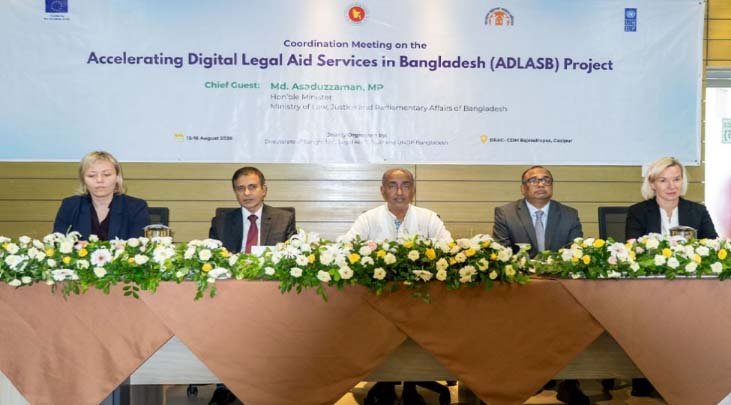
Photo : Collected
Bangladesh is advancing efforts to make government legal aid services more accessible and efficient through digitalisation.
A two-day coordination meeting on 15–16 August brought justice sector stakeholders together at BRAC-CDM, Gazipur to support the rollout of the new Digital Legal Aid System under the “Accelerating Digital Legal Aid Services in Bangladesh” project.
Implemented by the Directorate of Bangladesh Legal Aid (DBLA) under the Ministry of Law, Justice and Parliamentary Affairs, with financial support from the European Union and support from the United Nations Development Programme (UNDP), the project aims to modernise legal aid delivery.
The new system is expected to simplify legal aid applications, case tracking, lawyer assignment, mediation, notifications and data management.
The event brings together judges and legal aid officials to strengthen local legal aid mechanisms, advance digital service delivery and make justice more accessible to underserved communities. The initiative will focus on activating Upazila and Union Legal Aid Committees, improving digital case management and promoting online dispute resolution across Rajbari, Habiganj, Barguna, Netrokona, Joypurhat, Thakurgaon, Jhenaidah and Khagrachhari.
A key focus of the meeting is the selection and functionalisation of 45 Upazila Legal Aid Committees and 300 Union Legal Aid Committees across the eight districts. These committees are expected to bring legal aid services closer to communities, particularly for people who face financial, geographic or social barriers in accessing formal justice institutions
The opening inauguration session was attended by Md. Asaduzzaman, Minister, Ministry of Law, Justice and Parliamentary Affairs; Liaquet Ali Molla, Secretary, Law and Justice Division, Md. Monjurul Hossain, Director General, Directorate of Bangladesh Legal Aid (DBLA); Baiba Zarina, Chargé d’Affaires of the European Union Delegation to Bangladesh; and Ms Romana Schweiger, Senior Rule of Law, Justice and Security Advisor, UNDP Bangladesh.
Speaking as the chief guest at the inauguration, Lae Minister Md. Asaduzzaman said, “Access to justice means ensuring human rights. Every citizen has inalienable, inherent and universal rights, and the State has a responsibility to ensure that citizens can access justice and exercise those rights”.
He also highlighted the importance of digitalisation, stronger public awareness of legal rights and legal aid services, greater institutional engagement by DBLA, and recognition of high-performing legal aid and judicial officers. “we are committed to reduce the backlog of cases within one year,” he said.
Law Secretary Liaquet Ali Molla said, “Our goal is simple: a person who needs legal aid should be able to access that service and have fair and accessible justice.”
Md. Monjurul Hossain, Director General of the Directorate of Bangladesh Legal Aid, said the project would strengthen coordination across the justice sector.
“Legal aid is basic infrastructure of a justice system, and digitalisation must make services fair, accessible and responsive to people,” said H.E. Baiba Zarina, Chargé d’affaires, European Union Delegation to Bangladesh.
“Introducing the digital legal aid platform is about making justice accessible for people; therefore the digital legal aid platform is designed according to the needs of the people, including women and vulnerable groups,” said Romana Schweiger, Senior Advisor, UNDP Bangladesh.
The meeting ended on 16 August with District and Sessions Judges from the eight districts discussing Online Dispute Resolution, committee activation, training, and legal aid data management, with particular attention to improving access for women, persons with disabilities and people living in poverty. It will conclude with commitments from the Chairs of the eight District Legal Aid Committees to strengthen digital legal aid delivery and expand access to justice at the local level.