Weekly Bangla Mirror | Bangla Mirror, Bangladeshi news in UK, bangla mirror news

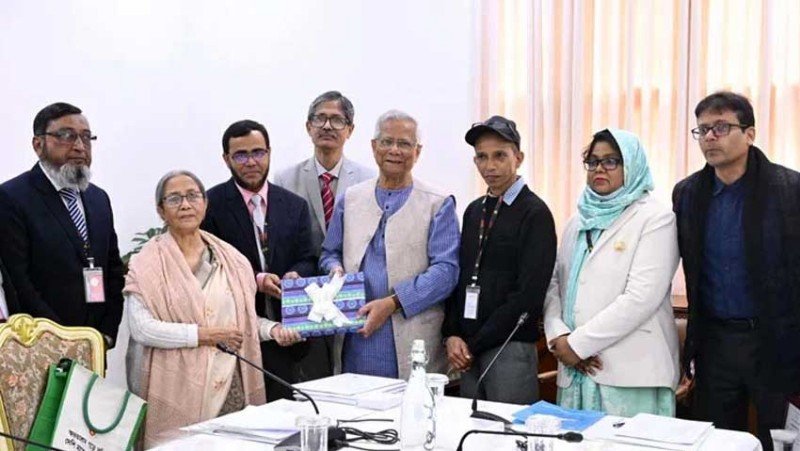
Chief Adviser Professor Muhammad Yunus on Tuesday stressed the need for extensive deep-sea research and clear identification of challenges to ensure the proper utilization of country’s vast marine resources.
He made the remarks while receiving a survey and research report on marine fisheries resources and ecosystems, prepared following a study conducted by research vessel RV Dr Fridtjof Nansen.
The report was submitted at a meeting held on Tuesday morning at State Guest House Jamuna, according to the Chief Adviser’s Press Wing.
Fisheries and Livestock Adviser Farida Akhter, Chief Adviser’s Special Envoy on International Affairs Lutfey Siddiqi, Professor Dr Sayedur Rahman Chowdhury of Chittagong University Institute of Marine Sciences and Assistant Director of Department of Fisheries Dr Md Abdullah Al-Mamun were present at the meeting.
Professor Yunus noted that Bangladesh’s marine area is almost equal to its landmass, yet the country has failed to fully understand or utilize these resources.
“We have not been able to properly assess the scale and potential of our marine resources,” he said, adding that effective utilization would require adequate research and strong policy support.
He also emphasized the importance of joint marine research initiatives with countries such as Japan, Indonesia and the Maldives.
“We must clearly identify the problems and coordinate research with experts who have specialized knowledge. Through this process, new economic horizons will open up,” he said.
The survey was conducted from August 21 to September 21 last year by a team of 25 scientists from eight countries, including 13 Bangladeshi researchers.
Presenting the findings, Professor Sayedur Rahman Chowdhury informed the meeting that the research identified 65 previously unrecorded aquatic species in Bangladesh’s marine waters.
He also reported a sharp increase in jellyfish populations in the deep sea, describing it as a sign of ecological imbalance caused by overfishing.
The study further revealed the presence of plastic waste at depths of up to 2,000 meters, which researchers termed a matter of serious concern.
Comparisons with a 2018 study showed a significant decline in large fish populations in deep-sea areas, while fish stocks in shallow waters are decreasing at an even faster rate.
According to the findings, around 270 to 280 large fishing trawlers operate in deep-sea fishing, about 70 of which use sonar-based targeted fishing methods.
Researchers described sonar-based fishing as highly aggressive, benefiting deep-sea operators while severely harming fishers who depend on shallow-water fishing.
Fisheries and Livestock Adviser Farida Akhter warned that continued targeted fishing could leave the Bay of Bengal depleted of fish.
“The government will take a decision regarding sonar fishing,” she said.
The research also found an abundance of tuna in Bangladesh’s deep-sea waters, indicating strong potential for its sustainable exploitation.
In addition, a fish nursery was identified beneath the Sundarbans and the government has already issued instructions to ensure its protection.
The meeting was also informed that the United Kingdom’s Royal Navy is in the process of handing over a multi-role hydrographic and oceanographic survey vessel, HMS Enterprise, to Bangladesh Navy.
The vessel will support seabed mapping, depth measurement and marine data collection, significantly enhancing Bangladesh’s marine research capacity.