Weekly Bangla Mirror | Bangla Mirror, Bangladeshi news in UK, bangla mirror news
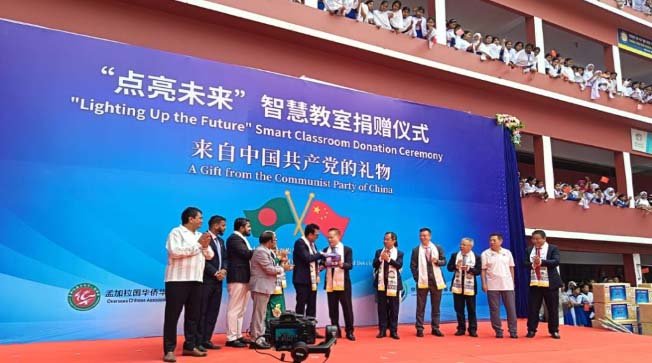
Education and Primary and Mass Education Minister Dr ANM Ehsanul Haque Milon inaugurating smart classrooms and a Chinese language programme at Shamsul Haque Khan School and College in Matuail, Dhaka, on Thursday. Photo : Collected
Education and Primary and Mass Education Minister Dr ANM Ehsanul Haque Milon has said education, technology and language learning will play a key role in strengthening Bangladesh-China relations, with cooperation extending beyond diplomatic agreements to schools and classrooms.
He made the remarks while inaugurating smart classrooms and a Chinese language programme at Shamsul Haque Khan School and College in Matuail, Dhaka, on Thursday.
The minister said the friendship between Bangladesh and China, established during the tenure of Shaheed President Ziaur Rahman, had been further strengthened under Prime Minister Tarique Rahman.
He said the two countries should take their friendship beyond speeches and signed agreements and extend it to the grassroots level through educational cooperation.
“Our friendship should not remain limited to speeches, documents or the signing of memorandums of understanding. It should become closer through cooperation in education, starting from primary schools,” he said.
Milon said he wanted to introduce smart classrooms, computer education and Chinese language learning in an area representing ordinary and middle-income families rather than limiting such opportunities to affluent neighbourhoods.
He said the government was placing greater emphasis on education and had increased the education budget under the leadership of Prime Minister Tarique Rahman.
The minister also highlighted initiatives to introduce sports and cultural activities from Class IV and the ‘Learning with Happiness’ approach in Classes V and VI. He said technical and vocational education was also receiving priority to prepare students for a technology-driven future.
Referring to Bangladesh – China educational cooperation, Milon said his recent engagement with Chinese counterparts had opened up new opportunities for collaboration. He expressed hope that the longstanding friendship between the two countries would continue to grow through educational initiatives benefiting younger generations.
Liu Haixing, head of the International Department of the Communist Party of China (CPC) Central Committee, expressed happiness over the warm reception in Bangladesh and the enthusiasm shown by students towards China.
Praising the students for singing Chinese songs, he said their performances reflected their affection for China and its people.
He said Bangladesh and China had enjoyed longstanding historical and cultural connections. Recent exchanges between the leaders of the two countries had taken bilateral relations to a new level, he added.
Liu said education was an important component of the 13 agreements signed between the two countries during the recent high-level engagement.
He described the inauguration of the smart classrooms as a practical step towards implementing the commitments made by the leaders of both countries to strengthen educational cooperation.
He said two smart classrooms equipped with computers from Chinese technology company Huawei had been provided to the institution.
Liu expressed hope that the classrooms would open a window to the digital world for students and help them build a brighter future.
Among others, Engr Sheikh Korban Ali, president of the China-Bangladesh Education and Culture Exchange Association, senior officials of the Education Ministry, members of the Chinese delegation, teachers, students and invited guests attended the programme.