Weekly Bangla Mirror | Bangla Mirror, Bangladeshi news in UK, bangla mirror news
Collected Photo
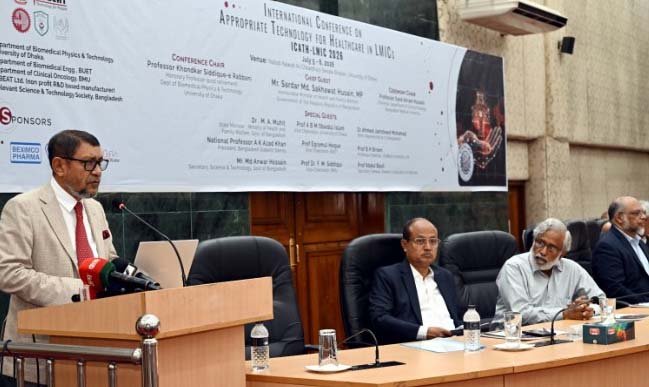
Health and Family Welfare Minister Sardar Md. Sakhawat Hossain today said the government is working to address the gaps in disease diagnosis and ensure better healthcare services, especially at the grassroots level.
Speaking as the chief guest at the inauguration of a two-day international conference titled “Appropriate Technology for Healthcare in Low and Middle Income Countries” at the Dhaka University (DU) Senate Building here, he said the government has doubled the allocation for the health sector in the national budget to achieve this goal.
The conference has been jointly organized by the Department of Biomedical Physics and Technology of the university, the Department of Biomedical of the Engineering of Bangladesh University of Engineering and Technology (BUET), the Department of Clinical Oncology of Bangladesh Medical University, BiBeat Limited and the Relevant Science and Technology Society.
The minister said expanding of technology-based healthcare services is essential to strengthening the country’s diagnostic capacity. He noted that the government is implementing various initiatives to deliver quality medical services to the rural and marginalized communities.
“Patients in remote areas are still being deprived of proper healthcare services. The government is committed to improving this situation quickly. To achieve this goal, the health sector allocation has been doubled in the national budget,” he said.
Expressing concern over the ongoing dengue situation, Sakhawat Hossain said some hospitals are struggling with an overwhelming number of patients, forcing them to accommodate 30 to 40 dengue patients in a single room.
Highlighting the government’s support for indigenous medical technology development, he praised the Dhaka University’s telemedicine programme, which incorporates modern technologies such as online 12-lead ECG and electronic stethoscopes.
He said integrating these technologies into the government’s new rural healthcare programme could bring significant improvements to the healthcare delivery in rural areas.
The minister also urged the doctors and the nurses engaged in tackling dengue and measles outbreaks to continue performing their duties with greater patience and professionalism.
He said improving the country’s diagnostic system through the effective use of advanced technology remains one of the government’s top priorities. He added that the hospitals have been instructed not to discharge dengue patients until they have made a full recovery.
During the inaugural session, conference chairman Professor Khondkar Siddique-e-Rabbani highlighted the country’s progress in healthcare technology innovation since 1978, while Vice-Chairman Professor Toufiq Hasan presented innovations in biomedical technologies developed at BUET and discussed entrepreneurship in the sector.
Technical sessions at the conference covered a wide range of topics, including prevention of postpartum haemorrhage, oral rehydration programmes, children’s neurological development, dry eye treatment, diabetic foot ulcer prevention, artificial intelligence, electrical bio-impedance and affordable medical technologies.
Participants also proposed the establishment of two international initiatives – the Global Institute of Appropriate Technology for Mankind and the Global Alliance for Equalizing Access to Healthcare Technology – to help reduce disparities in access to medical technologies across the developing countries.
On the second day of the conference, technical sessions will focus on cancer treatment, palliative care, and prevention of hospital-acquired infections, low-cost medical technologies and the application of artificial intelligence in healthcare.