Weekly Bangla Mirror | Bangla Mirror, Bangladeshi news in UK, bangla mirror news
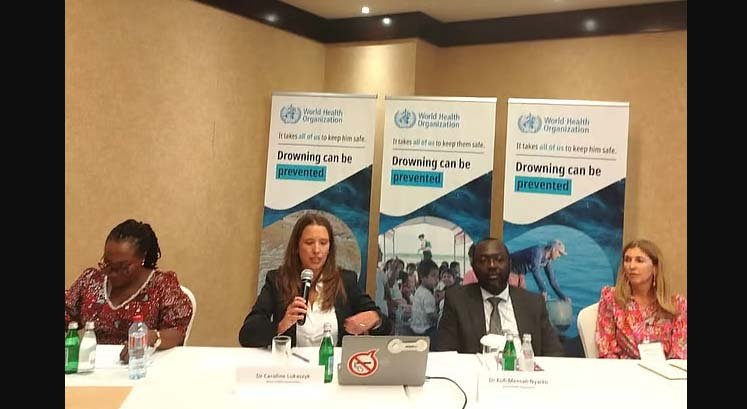
The World Health Organization will present a guidance document to help member states develop effective policies for drowning prevention. An international conference for that purpose began in Accra, the capital of Ghana, on Wednesday. (Collected Photo)
Although most of deaths from drowning are preventable, more than 300,000 people die from drowning around the world every year.
As drowning has long remained one of the most neglected public health issues, the World Health Organization (WHO) and the United Nations now consider it a global priority.
To that end, WHO released the Global Strategy for Drowning Prevention last year (2025), aiming to reduce drowning deaths worldwide by 35 per cent by 2035.
Caroline Lukaszyk, Technical Officer, Unintentional Injury at World Health Organization, said WHO will work closely with member states to achieve the target of reducing drowning deaths by 35 per cent by 2035. Member states will also receive the necessary support to implement effective interventions.
To help member states formulate effective policies on drowning prevention, WHO will present a guidance document. An international conference for that purpose began on Wednesday in Accra, the capital of Ghana.
Representatives from Bangladesh, India, the United States, Ghana, Uganda and Vietnam, including non-governmental organisations and media professionals, are attending the conference. These six countries, including Bangladesh, record relatively high numbers of drowning deaths.
Two sessions were held on the opening day. The event has been organised by the World Health Organization with support from Bloomberg Philanthropies. A press conference was also held by WHO in the evening.
At the press briefing, Caroline Lukaszyk said drowning occurs in every country in the world. Unfortunately, however, it has not received the attention it deserves. “So many deaths are simply unacceptable. They must be prevented,” she said, adding that the World Health Organization aims to reduce global drowning deaths by at least 35 per cent by 2035.
Lukaszyk said that while some countries have policies or laws aimed at preventing drowning, most do not. Even where such measures exist, their effectiveness often remains uncertain.
Speaking at the same press briefing, Kofi Mengaka Nyarko, WHO Regional Adviser for Africa, said many drowning deaths around the world go unrecorded.
He added that developing a strong drowning surveillance and data system is essential for preventing deaths, noting that many countries still lack such systems. Drowning has become a major public health concern across many African countries.
According to WHO’s global strategy published last year, more than 300,000 people died from drowning worldwide in 2021. One in four victims was under the age of five, while nearly half were younger than 29. More than 90 per cent of drowning deaths occurred in low- and middle-income countries.
For many of these countries, drowning is not only a public health issue but also a major development and economic challenge. In some countries, the economic cost of drowning is estimated to be as high as 3 per cent of gross domestic product (GDP) annually.
The strategy also highlights that drowning is preventable. Effective measures include safe supervision of children, protective barriers around water bodies, swimming and water safety education, rescue and first aid training, and ensuring the safety of water transport.
WHO first identified drowning as a public health issue in 2002. In 2003, a drowning prevention project was launched in Bangladesh. In 2014, WHO published its first global report on drowning.
In 2021, the United Nations General Assembly adopted its first-ever resolution on drowning prevention and declared 25 July as World Drowning Prevention Day. In 2023, the World Health Assembly also adopted a separate resolution on the issue.
Reports by the United Nations and several international organisations have pointed out that Bangladesh lacks accurate and regular reporting on drowning deaths.
However, various estimates suggest that more than 18,000 people die from drowning in the country every year. Of them, around 11,000 are children under the age of five.
Earlier on Wednesday, representatives from organisations working on drowning prevention in the United States, India, Vietnam and Uganda shared their experiences during the morning session.
Tessa Clemens, a representative of the CDC Foundation in US, said that drowning deaths are concentrated in 11 US states, with Alaska recording the highest burden. She noted that climate change has increased the frequency of extreme rainfall and flooding, contributing to a higher risk of drowning.
Meghendra Banerjee, Chief of Programs at Child in Need Institute in India, said drowning is still not treated as a major public health issue despite the large number of lives it claims.
He noted, however, that the Government of West Bengal has recently instructed district administrations to report drowning deaths. According to him, this initiative indicates that the government has become more attentive to drowning prevention.