Weekly Bangla Mirror | Bangla Mirror, Bangladeshi news in UK, bangla mirror news
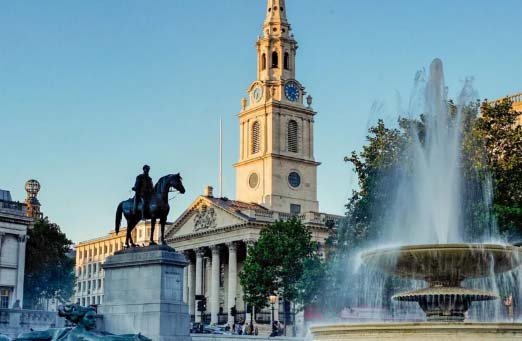
The current St Martin-in-the-Fields building opened in 1726 when George I was the reigning monarch
For 300 years, the towering Gothic steeple and temple-like columns of St Martin-in-the-Fields have stood at the corner of London’s Trafalgar Square, with the building’s three century-long history now being explored in a new exhibition.
St Martin’s position at the heart of the capital makes it the parish church for the residents of Buckingham Palace, 10 Downing Street and the Admiralty, with Britain’s Royal Family and ruling classes using it as a place of worship.
Yet the church also has a surprising past of radicalism and influencing change; a place of activism and protest inside a building whose design was replicated in more than a thousand churches around the world and which hosted the first live broadcast of a religious service.
“St Martin’s really has both epitomised and redefined what it means to be a church,” says its archivist Louisa Price.
Several versions of St Martin-in-the-Fields have stood on this site over the centuries, with the first mention recorded in 1222.
However, it is the current church designed by Scottish architect James Gibbs in 1726 which is familiar to people around the world, even those who haven’t been to London.
Two years after the church opened, Gibbs published his designs in a book which would influence the creation of more than a thousand churches around the world, with St Martin’s-type buildings still to be found everywhere from Kolkata to Manhattan.
“What you forget is, before 1726 no church in the world had ever looked like St Martin-in-the-Fields so it was a unique combination of different styles,” explains St Martin’s vicar, the Reverend Sam Wells.
“It really caught on as the standard design… and I think once that had set in, people wanted their church to look like a proper church, and this is what a proper church ended up looking like, particularly in America.”
Like other churches, St Martin’s looked to help those in its parish over the next century, establishing everything from bathhouses and police stations to a workhouse and schools.
However, it was already showing signs of breaking from the norm, with everything from opening London’s first free lending library to installing gas lighting in 1810, something seen as particularly controversial, according to Price.
“You think today, that’s practical having better lighting. And actually, at the time, a lot of leading clergy were saying that gas was unholy and a profane thing.”
And this attitude only continued with the activities of St Martin’s vicar, the Reverend Dick Sheppard, during World War One.
Seeing troops heading off to France from Charing Cross, Sheppard declared St Martin’s to be the “Church of the Ever Open Door” and opened the crypt 24 hours a day to provide them with shelter, while turning a blind eye to who they spent their last night with.
Even once the fighting was over, he kept the crypt open, with tens of thousands of people going on to use it as a place of refuge.
“You get homeless people who need somewhere to sleep, you get people who miss the last bus home who can just shelter in here and they just keep it going,” explains Price.
“Whilst the church isn’t open 24/7 any more it is still an incredibly welcoming space… and even if you go up now, the gentle sound of snores tends to just ripple through the church quite a lot, and I think that’s really beautiful.”
Sheppard also embraced innovation and so when BBC managing director Lord Reith approached him about plans to broadcast the first live church service in January 1924 he was keen to take part.
Again such a move was frowned upon by other clergy, the Dean of Westminster considering the idea that “the gospel should be exposed to the hearing of fellows drinking their pots of beer with their hats on in public houses” to be a scandal.
Yet the reaction was hugely positive with listeners calling it “spell-binding” and “an intellectual treat”, even if some did write in complaining about “how loud-sounding are the boots of your congregation”.
As such the broadcasts continued and spread St Martin’s reach around the UK, then across the world with them also being played on the BBC World Service.
“I’m told a third of the population of this country listened to the evening service from St Martin-in-the-Fields on a Sunday. I mean, it’s staggering,” says Wells.
Sheppard’s first service would also start another tradition still going today, the annual BBC Radio 4 Christmas Appeal.
Each year at Christmas, Sheppard called for those in his congregation to help the poor of the parish but when his appeal went nationwide, donations started coming in from elsewhere.
This has continued each year and Wells is set to take part in the 100th appeal this Christmas, with the money used to help the homeless through St Martin’s charity, The Connection.
Another side of the church is its place as a hub for activism and protest.
Amnesty International would be founded from the church in the 1960s as a reaction to two students being wrongfully imprisoned in Portugal, with other charities like the Big Issue and Shelter also starting from St Martin’s.
The church’s position by Trafalgar Square also means its stairs have often been used as a base for demonstrations, as seen most clearly with the anti-apartheid demonstrations during the 1980s.
“The church steps, the flagpole, even the bells have become part of us being able to communicate the church’s position,” says Price.
For Wells, this ability of St Martin’s to be both a parish church for those at the centre of power, but also a place for those at the periphery of society, is reflected in its location.
“We have this phrase ‘at the heart on the edge’, because we’re at the heart of London, but on the edge of Trafalgar Square.
“That’s part of the kind of mythology… there’s that endless contrast. But that’s kind of part of being London, I think.”
And as for what it’s like to be the local vicar for the Royal Family…
“I did once meet the former Duke of Edinburgh at Buckingham Palace and he said, ‘Who are you and why are you here?’ and I said, ‘I’m your vicar’,” says Wells.
“I don’t think he found that terribly funny, but I did.”